- Category
- Vegetables
- State
- Fresh
- Usual unit
- unit
What it is
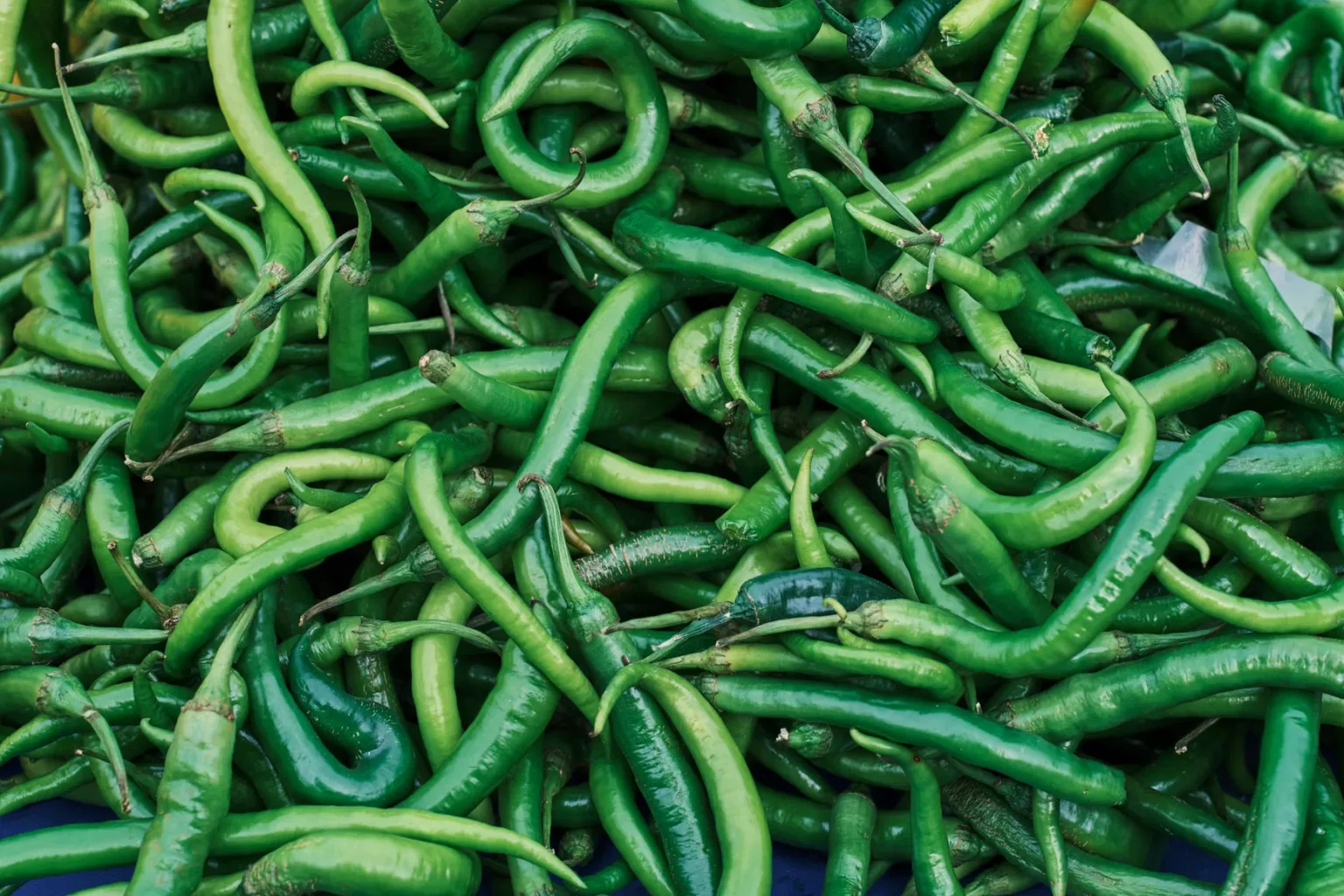
Thai green chillies are fresh chilli fruits used as a vegetable ingredient in cooking. The word “green” describes their color, but the available evidence does not identify one specific botanical variety or establish that every chilli has the same size or heat level. Chiles in general are used for their flavor and pungency; the seeds and pale inner portion can contribute to that sensation. In the kitchen, these chillies can be sliced or minced to distribute their heat, added to a chile preparation, or cooked with other ingredients. Treat them as a hot ingredient whose strength should be checked during preparation, rather than assuming that a fixed amount is interchangeable with any other chilli.
When to use it
Use them when you want to add heat and can adjust the amount to suit the people eating the dish. They can be used in chile sauces and stir-fried dishes, or combined with tomato and onion in salsa and with vinegar in a chile preparation. If you do not know how hot they are, begin with a small amount, taste, and add more only if needed. Removing the seeds and pale inner portion may reduce the heat, but it does not guarantee a mild result.
How to use it
First decide how much heat you want in the dish. Slice or mince the chillies to distribute them more evenly; to reduce their pungency, remove the seeds and pale inner portion. Add them gradually and taste before adding more, since heat should not be assumed to be identical from one chilli to the next. They can also be cooked in a stir-fry or used in a chile sauce. Tomato, onion and vinegar appear in documented preparations involving chiles, though the proportions depend on the recipe. The available evidence does not give cooking times for this ingredient, so follow the method and doneness specified by your recipe.
Flavour and texture
Their clearest culinary feature is heat, which may be perceived at different intensities from one chilli to another. The available material does not reliably describe an aroma or texture unique to Thai green chillies. When cut, the seeds and pale inner portion are exposed; removing them may reduce pungency. Taste a small amount in the dish before deciding whether to add more.
How to choose it
Look for chillies identified as Thai green chillies and sold fresh if that is what your recipe calls for. The available evidence does not provide specific criteria for firmness, size or ideal color, so these should not be presented as definitive quality tests. If the level of heat matters, ask about the batch or buy a small amount to test before planning a larger preparation.
Storage
The supplied evidence does not establish specific storage conditions or a storage life for Thai green chillies. Buy only the amount you expect to use and follow any storage directions from the retailer or packaging. Do not assume that guidance for dried, canned or sauced chiles also applies to fresh chillies.
Substitutions
If Thai green chillies are unavailable, try another small, hot green or red chilli. The substitute may change both the heat level and character of the dish; the evidence does not establish an exact quantity-for-quantity replacement. Add it gradually, taste, and adjust rather than automatically using the same amount.
Common mistakes
A common mistake is adding a large amount before tasting, especially when the chilli’s heat is unknown. Another is assuming that removing the seeds eliminates all the heat: the pale inner portion can contribute too, and the result still depends on the chilli. Do not automatically substitute the same amount of a different variety or apply instructions for dried or canned chiles to fresh ones.
Safety and allergens
Use ordinary food-hygiene practices when preparing this ingredient. The available evidence contains no specific official safety warning for Thai green chillies; do not turn general guidance into undocumented, ingredient-specific storage or safety instructions.
Culinary uses
- Fresh heat and chile flavor in dishes
- Ingredient for chile-based sauces and relishes
Recommended techniques
- Slice or mince for more even distribution
- Remove seeds and the pale inner portion to reduce pungency
- Stir-fry as part of a dish
Pairs well with
- Tomato and onion in chile-based salsa
- Vinegar in chile sauce preparations
Frequently asked questions
Does removing the seeds reduce the heat?
It may reduce the heat, especially if you also remove the pale inner portion, but it does not guarantee a mild chilli.
Can I use another chilli if I cannot find these?
You can try another small, hot green or red chilli. Add it gradually because no exact substitution ratio is documented.
How long do fresh Thai green chillies keep?
The available evidence does not specify a storage life or particular conditions. Follow the retailer’s or packaging’s directions, if provided.
Sources and review
Automatically researched, cross-checked and validated content. Sources consulted:
- Client Challenge doi.org
- The Essential Glossary of Cooking Terms for the Culinary Arts - Escoffier escoffier.edu
- Agencia Española de Seguridad Alimentaria y Nutrición aesan.gob.es
- Cookbooks and Reading Suggestions - UNT Food Pantry - Guides at University of North Texas guides.library.unt.edu
- El chile — Canela Limón Chile canelalimonchile.com
- 10 Essential Cooking Tips to Improve Kitchen Skills northbridge.edu
- Food and Beverage Management - eCornell ecornell.cornell.edu
- Chile Salsa II - National Center for Home Food Preservation nchfp.uga.edu
- Grubhub: Food Delivery App - App Store my.pitt.edu
- Request Info | Institute of Culinary Education ice.edu
- GET Mobile App - App Store mizzouone.missouri.edu
- Plant-Based Culinary Arts | Le Cordon Bleu Dusit cordonbleu.edu
- COLLECTION: Salsas (3) cs.cmu.edu
- Chile Thai: cultivo, riego y cosecha en 70 días plotmygarden.com
- - YouTube youtube.com