- Category
- Other
- State
- Liquid
- Usual unit
- teaspoon
What it is
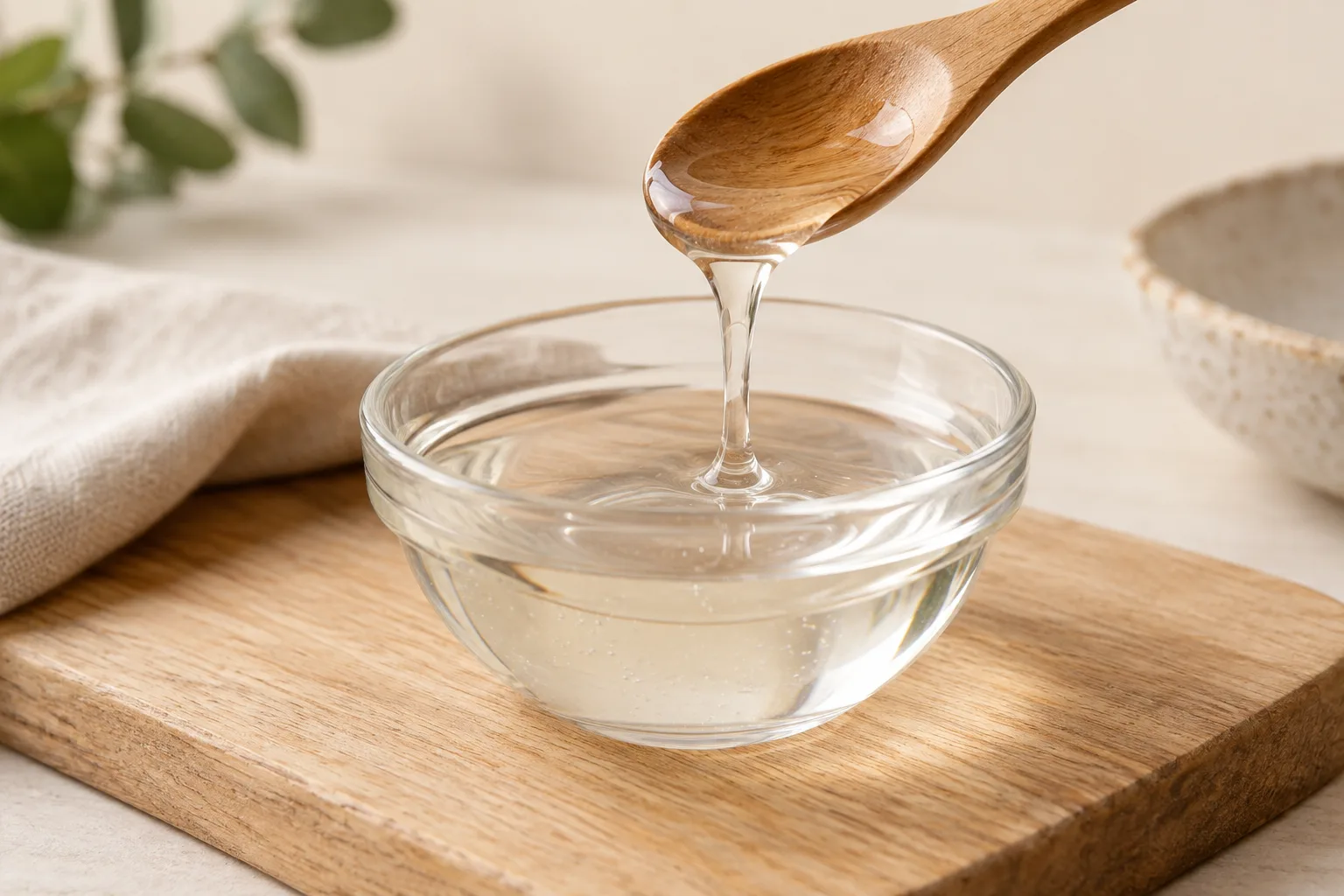
Food-grade glycerine, also known as glycerol, is a clear, viscous liquid with a sweet taste. In foods it may be identified as E-422. It is used mainly for its humectant properties and its ability to modify texture: it can help keep some baked goods and sweets tender and make fondant more flexible. It is also used in certain beverages and frozen preparations. The name glycerine is used for products intended for different purposes, so the name alone does not show that a product is suitable for cooking. Choose only a product whose label clearly states that it is suitable for food use. Its effect depends on the formulation and amount, so it is not a universal replacement for sugar, honey or other syrups.
When to use it
Use it when a recipe is intended to retain moisture or adjust flexibility and texture, for example in fondant, icings, some sweets or baked goods. It may add body to certain beverages and help soften some frozen preparations. It is not needed in every recipe and does not, by itself, replace ingredients that provide structure or sweetness. If the recipe specifies glycerine, follow its directions; otherwise, add it only when you have a clear culinary purpose and can account for its effect on the result. Different preparations may call for different amounts, so there is no single dose that applies to every use.
How to use it
Before you begin, check that the package states the product is suitable for food use, then follow the recipe or manufacturer’s directions. Add it gradually and mix thoroughly so it is evenly distributed. In fondant, it may help improve flexibility and handling; in sweets and baked goods, it is used to help retain moisture and modify texture. The appropriate amount varies by preparation, so do not transfer a proportion from one recipe to another without guidance. Too much may make the result overly soft or sticky. Do not use cosmetic glycerine or a product whose suitability for food use you cannot confirm as a culinary ingredient. If a recipe does not specify glycerine, do not add it automatically: first decide what function it is meant to serve.
Flavour and texture
It has a sweet taste and a clear, viscous liquid consistency. Although its taste may be noticeable, it is used mainly to affect moisture and texture rather than as the primary sweetener. Depending on the preparation, it can contribute to a softer or more flexible feel, particularly in icings and fondant. Too much may make the result sticky or overly soft. The final effect depends on the food and amount used, so follow the recipe rather than assuming it will work the same way in every mixture.
How to choose it
Choose a product whose package clearly states that it is suitable for food use. Check the label, manufacturer and directions before adding it to a recipe; do not rely on the word “glycerine” alone, since products for other uses are also sold. If a preparation requires a particular specification, check that the package states it instead of assuming all products are interchangeable. If you cannot confirm that it is intended for food use, do not use it as an ingredient.
Storage
The available sources do not establish a universal storage method or shelf life for every food-grade glycerine product. Follow the manufacturer’s storage directions and keep the product in the container specified. Check the label before use, and do not use it if you cannot confirm its suitability for food use from the available information. Do not apply storage guidance for other products by assumption; the package directions are the available reference for each product.
Substitutions
There is no universal substitute because glycerine may provide moisture, flexibility or body depending on the recipe. Some preparations may allow partial replacement with honey or syrup, but sweetness and texture can change; do not substitute in equal amounts unless a formula says to. If glycerine does not serve an essential function, you can omit it, while allowing for a drier or otherwise different result. To preserve the intended outcome, it is best to follow the original recipe.
Common mistakes
Do not confuse food-grade glycerine with glycerine products intended for cosmetics or other purposes: the name alone does not confirm that a product is a culinary ingredient. Avoid adding an improvised amount, since too much may make a preparation soft or sticky. Do not treat it as a complete replacement for sugar, honey or syrup either; their functions and effects are not equivalent and depend on the formulation.
Safety and allergens
Use only a product whose label clearly confirms that it is suitable for food use, and follow the manufacturer’s and recipe instructions. Do not use cosmetic products or products whose suitability for food use you cannot confirm. The available sources do not establish a specific official safety warning or universal storage instructions for this ingredient.
Culinary uses
- Humectante para ayudar a retener la humedad
- Modificador de textura y flexibilidad en fondant y dulces
- Aporte de cuerpo a algunas bebidas y preparaciones
Recommended techniques
- Incorporar gradualmente a la preparación siguiendo la receta o la etiqueta
- Mezclar con fondant para ayudar a mejorar su flexibilidad y manejo
- Añadir a dulces para ayudar a modificar la textura y limitar la cristalización del azúcar
Pairs well with
- Fondant y coberturas de azúcar
- Bizcochos y magdalenas
- Caramelos y otros dulces
- Bebidas y algunas preparaciones congeladas
Frequently asked questions
Is food-grade glycerine the same as glycerol?
Glycerine and glycerol are names used for the same ingredient; in foods it may also be identified as E-422.
What is it used for in baking?
It is used mainly to help retain moisture and adjust texture. It may help make fondant more flexible and modify the texture of some sweets and baked goods.
Can I use any glycerine I have at home?
No. Use only a product whose label confirms that it is suitable for food use. Do not substitute cosmetic glycerine or a product with uncertain use or suitability.
What happens if I add too much?
Too much may make a preparation overly soft or sticky. Follow the recipe or manufacturer’s directions; there is no single proportion for every use.
Sources and review
Automatically researched, cross-checked and validated content. Sources consulted:
- Client Challenge doi.org
- BFSN_A_325050_O talcottlab.tamu.edu
- Food Labeling Guide marketready.uky.edu
- La Sierra Natural Foods - Financial Administration - La Sierra University lasierra.edu
- Sustratos con mucha mapa.gob.es
- Changes to the Nutrition Facts Label | FDA go.unl.edu
- South Carolina Home-based Food Production Law clemson.edu
- Cancer Hacks Revealed: Dr. William Li's Grocery & Supplement List for a Longer, Healthier Life: Osher Center for Integrative Health at Northwestern University: Feinberg School of Medicine feinberg.northwestern.edu
- Publications - UF/IFAS Animal Sciences - University of Florida, Institute of Food and Agricultural Sciences - UF/IFAS animal.ifas.ufl.edu
- How can I wash pesticides from fruit and veggies? npic.orst.edu
- Glicerina alimentaria - Apasa apasa.es
- Glicerina alimentaria. Qué es, para qué sirve y cómo usarla en cocina y repostería abc.es
- ¿Para qué sirve la glicerina alimentaria? Aquí las claves vadequimica.com
- Qué es la Glicerina y qué Usos Tiene - Farmacia Santamaría farmaciasantamaria.com