- Category
- Pulses
- State
- Fresh
- Usual unit
- cup
What it is
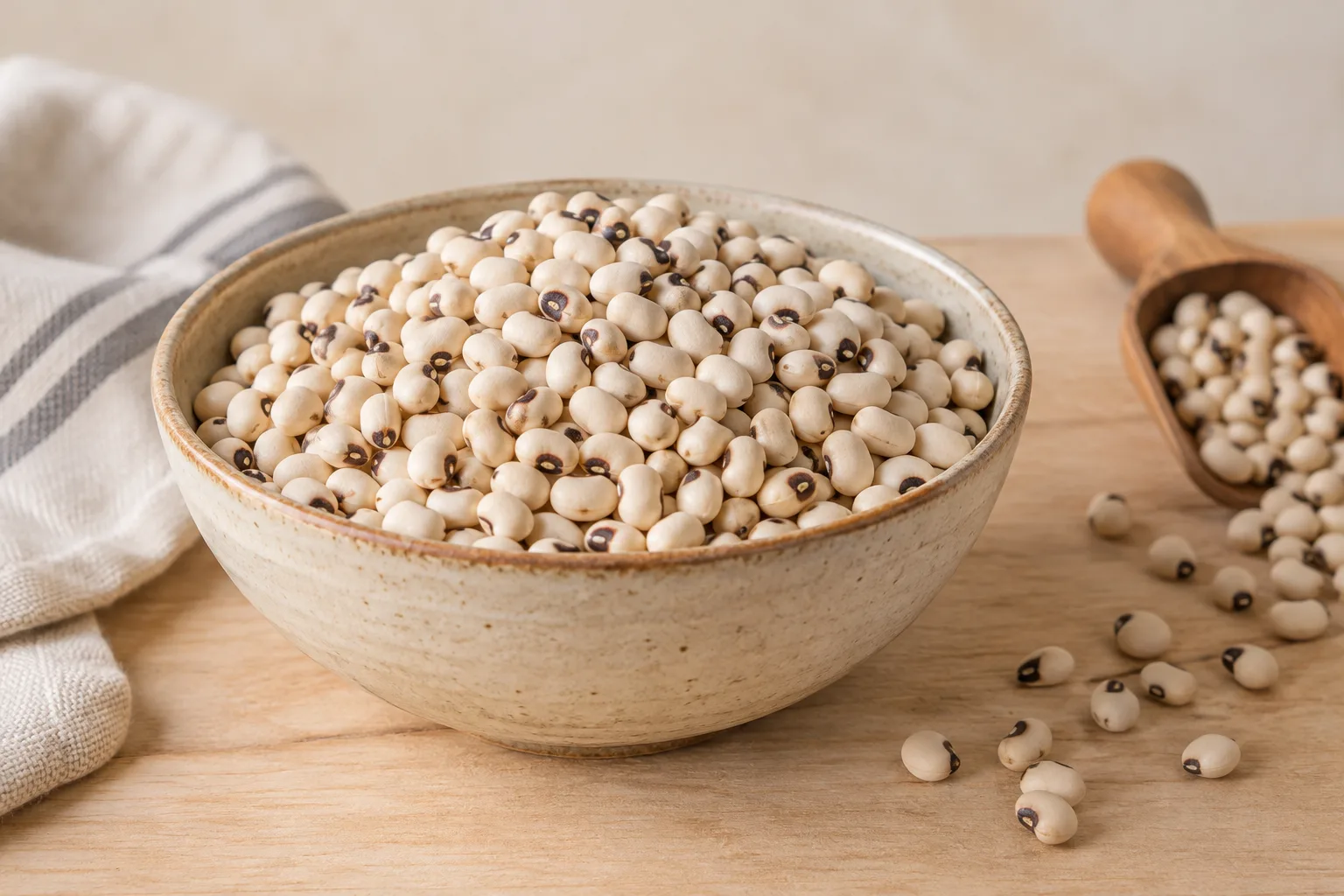
Nhemba cowpeas are identified in this profile as cowpeas, corresponding to Vigna unguiculata in the available study. They are legumes distinct from common beans, Phaseolus vulgaris. The research examined one cowpea variety combined with common beans to develop food products, so its findings apply to the particular varieties and preparations tested. The study describes soaking, cooking in water and removing the seed coat as pretreatments, but it does not provide a full description of fresh Nhemba or general home-cooking instructions. The fresh state supplied in the record is retained, although the culinary evidence focuses on seeds and processed products.
When to use it
Consider them when you want to add a legume to a bean preparation or try a blend with common beans. The research tested cowpeas as a partial substitute for common beans in fried-bean paste and precooked flour; these are studied applications, not a guarantee that every variety or form will work the same way. If you have the fresh product indicated in this record, follow the instructions supplied with it: the available sources do not explain how to transfer methods tested on seeds to that form.
How to use it
The available research evaluated soaking, cooking in water and removing the seed coat as cowpea pretreatments. In the study samples, these practices reduced the measured polyphenols. The researchers also made common-bean and cowpea blends for bean paste and precooked flour. These findings may inform a mixed preparation, but they do not show that a particular proportion or the same sensory result applies to every variety. The study summary does not give complete home-cooking instructions for fresh Nhemba; for that form, follow the product or seller’s specific directions rather than extrapolating undocumented cooking times.
Flavour and texture
The study described a characteristic earthy flavor in cowpeas and proposed that it might be related to polyphenols. Soaking, cooking and dehulling reduced those compounds in the samples examined. The researchers also assessed color, texture, salt level and flavor in blended products. These findings apply to the study’s samples and preparations; they do not establish a universal sensory profile for fresh Nhemba cowpeas.
How to choose it
Check the name and form on the label or with the seller. The cited research distinguishes cowpea, Vigna unguiculata, from common bean, Phaseolus vulgaris. The available sources do not give specific criteria for judging the freshness, size, color or commercial quality of Nhemba. If you need a particular form, confirm whether the product is fresh, dry or processed; this profile retains the record’s fresh state, but the study does not specifically characterize that form.
Storage
The available sources do not establish storage conditions, containers or shelf life specifically for fresh Nhemba cowpeas. Follow the package or seller’s directions for the product you have, and do not automatically apply advice for dry seeds to a fresh form. Research on other common-bean varieties links improper storage with hardening, but it is not enough to support a Nhemba-specific storage recommendation.
Substitutions
Cowpeas were studied as a partial substitute for common beans in blends intended for bean paste and precooked flour. The research used particular varieties and a particular proportion, so it does not show that cowpeas are an equivalent replacement in every dish. If you try a blend at home, treat the substitution as partial and adapt the method to the product and recipe instructions. The sources do not support a universal one-for-one swap.
Common mistakes
Do not confuse cowpeas with common beans: the study distinguishes Vigna unguiculata from Phaseolus vulgaris. Do not generalize findings from one variety and specific products to every form of Nhemba. Avoid assuming cooking times, proportions or storage conditions that the sources do not specify, especially for the fresh product indicated in the record.
Safety and allergens
The supplied sources contain no specific official warning or detailed safety instructions for fresh Nhemba cowpeas. Handle and prepare the product according to its package or the seller’s directions. Specific cooking times or recommendations for this form cannot be established here.
Culinary uses
- Legume ingredient for mixed-bean preparations
- Partial substitute for common beans in the studied products
Recommended techniques
- Soaking as a studied pretreatment
- Cooking in water as a studied pretreatment
- Removing the seed coat as a studied pretreatment
Pairs well with
- Common beans in mixed-bean preparations
- Bean paste and precooked flour preparations
Frequently asked questions
Are Nhemba cowpeas the same as common beans?
No. The research identifies cowpea as Vigna unguiculata and distinguishes it from common bean, Phaseolus vulgaris.
Can Nhemba replace common beans?
Cowpeas were studied as a partial substitute for common beans in blends for bean paste and precooked flour. The evidence does not establish a direct replacement in every recipe.
Which methods have been studied for cowpeas?
The study evaluated soaking, cooking in water and removing the seed coat as pretreatments. Its findings apply to the samples and preparations examined.
Sources and review
Automatically researched, cross-checked and validated content. Sources consulted:
- ¿Por qué la muerte es origen de miedos y tabúes? doi.org
- Client Challenge doi.org
- ¿Qué son los frijoles? Descubre tipos y variedades-Blog goya.es
- - YouTube youtube.com
- Frijol - Wikipedia, la enciclopedia libre es.wikipedia.org
- El Fríjol, El Alimento Que Hace Feliz A Tu Mesa Y A Tu Paladar | SaborUSA saborusa.com
- El Origen, Recetas Y Beneficios Del Frijol: Guía 2024 campograndeperu.com
- Uso del cowpea (Vigna unguiculata) en mezclas con fríjol común (Phaseolus vulgaris) en el desarrollo de nuevos productos alimenticios | Trabajo de investigación | Volumen 58 alanrevista.org
- Frijol (Phaseolus vulgaris L.) endurecido y alternativas tecnológicas para su aprovechamiento en la industria alimentaria* redalyc.org
- Sabores ancestrales, nutrición moderna: El frijol | Dirección General del Servicio de Información Agroalimentaria y Pesquera | Gobierno | gob.mx gob.mx