- Category
- Baking
- State
- Powdered
- Usual unit
- teaspoon
What it is
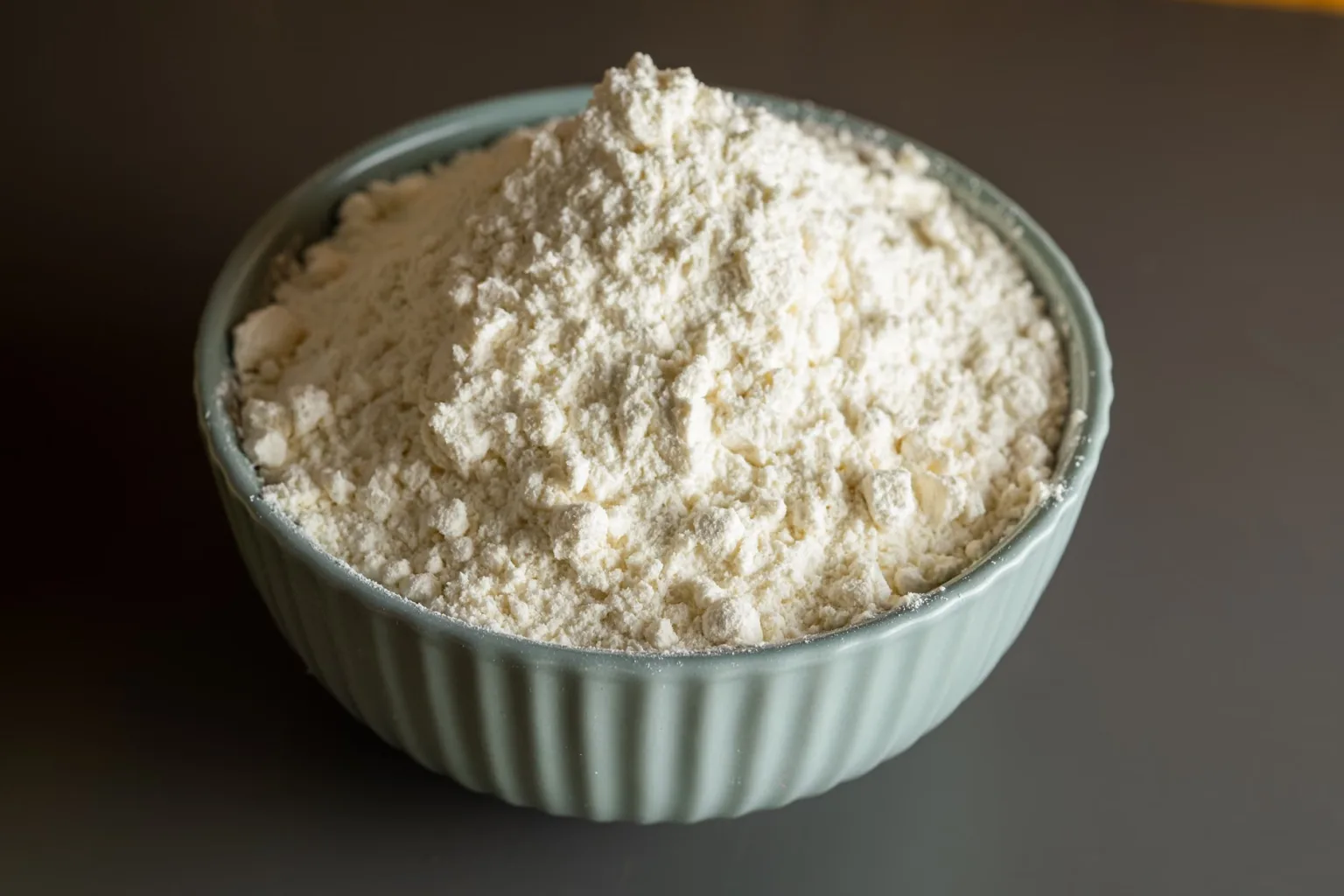
Baking powder is a dry mixture used to leaven batters and doughs. It commonly combines baking soda with one or more acidic components and often includes an ingredient that helps keep the mixture dry and free-flowing. When moisture is added, and for some products when heat is applied, it can release carbon dioxide. Bubbles of gas become trapped in the mixture and help it expand. Formulas differ, and some products release gas in more than one stage. Baking powder is not baker’s yeast, which is a microorganism; the two ingredients work differently and do not involve the same leavening process. Check the product label rather than assuming every brand has an identical formulation.
When to use it
Use it when a recipe calls for it to help give volume and a lighter crumb to cakes, biscuits, muffins, cookies and other baked mixtures. It can also be used in some savoury preparations, such as certain batters for coating food. Results depend on the product formula and the rest of the recipe, so do not add it automatically to every mixture or change the amount without considering the method. If a preparation relies on yeast fermentation or on air incorporated by a particular technique, baking powder will not necessarily produce the same result.
How to use it
Measure the amount stated in the recipe and distribute it evenly, usually with the dry ingredients when the method calls for that. Add the wet ingredients as directed. Some formulas begin reacting when moistened, while others also release gas with heat, so do not assume that every product behaves identically. If the recipe says to bake promptly, avoid leaving the mixed batter to stand. Do not replace baking powder directly with baking soda: baking powder already combines a base with acidic components, while baking soda needs suitable conditions in the recipe. Follow the stated quantities and mixing order for the particular preparation.
Flavour and texture
Baking powder is used for its effect on structure rather than as a seasoning. When measured as directed, it helps mixtures rise and develop a lighter, airier texture. Too much can harm the texture and leave an unpleasant taste; the result also depends on the recipe and the product type. Do not expect it to provide the flavour or process associated with baker’s yeast.
How to choose it
Choose a product labelled baking powder or chemical leavener and check its package instructions. Formulas vary: some work in multiple stages and others do not, so the name alone does not tell you exactly how a product will behave. Check the stated date and that the package is intact. If you need to avoid a particular ingredient, read the ingredient list and allergen information for that product rather than assuming all brands have the same composition.
Storage
Keep it tightly closed in a dry place and follow the manufacturer’s directions. Keep moisture out of the container; use a dry utensil for measuring and reseal the package after use. Moisture can affect performance, and clumps may indicate that the powder has become damp. Check the package date and instructions; appearance alone cannot confirm whether it is still effective.
Substitutions
Do not swap baking powder and baking soda in equal amounts without adjusting the recipe: they are not direct equivalents. Options described for leavening include a mixture of baking soda, cream of tartar and starch; baking soda with an acidic ingredient and recipe adjustments; or whipped egg whites in preparations where adding air is suitable. Each alternative can change texture, flavour or moisture, so use a reliable formula that fits the preparation.
Common mistakes
Do not confuse baking powder with baker’s yeast or plain baking soda. Avoid estimating the amount, exceeding the recipe quantity, or assuming every formula reacts in the same way. Too much can produce a poor texture or an unpleasant taste. Do not use a wet measuring utensil or leave the package open, since moisture can affect the product.
Safety and allergens
Check the specific product label for its ingredients, declared allergens and applicable directions for use or storage. Follow the package instructions and do not use the product if its label indicates that it is unsuitable for your situation.
Culinary uses
- Leavening agent for baked goods
- Helps create volume and a lighter, more open crumb
Recommended techniques
- Measure and combine with the dry ingredients as directed by the recipe
- Mix the batter and bake promptly when the recipe or product calls for it
Pairs well with
- Flour in cakes, biscuits, muffins and other baked mixtures
- Recipe ingredients that provide moisture, which activates many baking powder formulations
Frequently asked questions
Is baking powder the same as baker’s yeast?
No. Baking powder is a dry chemical leavener; baker’s yeast is a microorganism. They are used differently and are not automatically interchangeable.
Can I replace it directly with baking soda?
Not directly. Baking soda needs suitable acidic conditions, while baking powder already combines a base with acidic components. Substitution requires adapting the recipe.
How can I tell whether my baking powder is still suitable?
Check the package date and directions. Moisture and clumping can affect performance, but appearance alone does not confirm whether it is effective.
Estimated nutrition
- Fat
- 0 g
- Saturates
- 0 g
- Carbohydrate
- 0 g
- Sugars
- 0 g
- Protein
- 0 g
- Salt
- 14.58 g
Sources and review
Automatically researched, cross-checked and validated content. Sources consulted:
- TIEMPO-TEMPERATURA.pdf aesan.gob.es
- En el etiquetado alimentario hay algunas menciones que son obligatorias eletiquetadocuentamucho.aesan.gob.es
- Polvo gasificante - Wikipedia, la enciclopedia libre es.wikipedia.org
- Descubre Qué es el Polvo para Hornear y Cómo Usarlo para Lograr Postres Perfectos - Restaurante Marcos restaurantemarcos.es
- ¿Qué es el polvo para hornear y para qué sirve? - Rexal rexal.com
- Polvo De Hornear: Ingredientes, Tipos Y Usos | Doctor Online doctor-online.com.ar
- ¿Qué es el polvo para hornear? hz-focus.com
- Descubre qué es el polvo para hornear y de qué está hecho eluniversal.com.mx
- ¿Con qué se puede sustituir el polvo para hornear? ✅️ Sabor a Tierra y Mar saboratierraymar.es
- 5 productos que sirven de sustitutos para el polvo de hornear panaderiatito.com
- 5 ingredientes que sustituyen el polvo de hornear - Mejor con Salud mejorconsalud.as.com
- ▷ ¿Qué otro nombre tiene el polvo para hornear? | Como Cocinar y Comer comococinarocomer.com
- Hola necesito saber todo sobre el polvo de hornear, (sus origenes,usos,etc.) | La Verdad laverdad.es
- Client Challenge doi.org
- 3 ingredientes básicos con los que podrás sustituir el polvo de hornear en tus recetas bonviveur.com
- ¿No tienes polvo para hornear? 3 ingredientes de cocina que pueden sustituirlo en las recetas | Gastrolab gastrolabweb.com
- Sustitutos del Polvo de Hornear →【Mejores Alternativas 2026】 recetasis.com