- Category
- Vegetables
- State
- Fresh
- Usual unit
- g
What it is
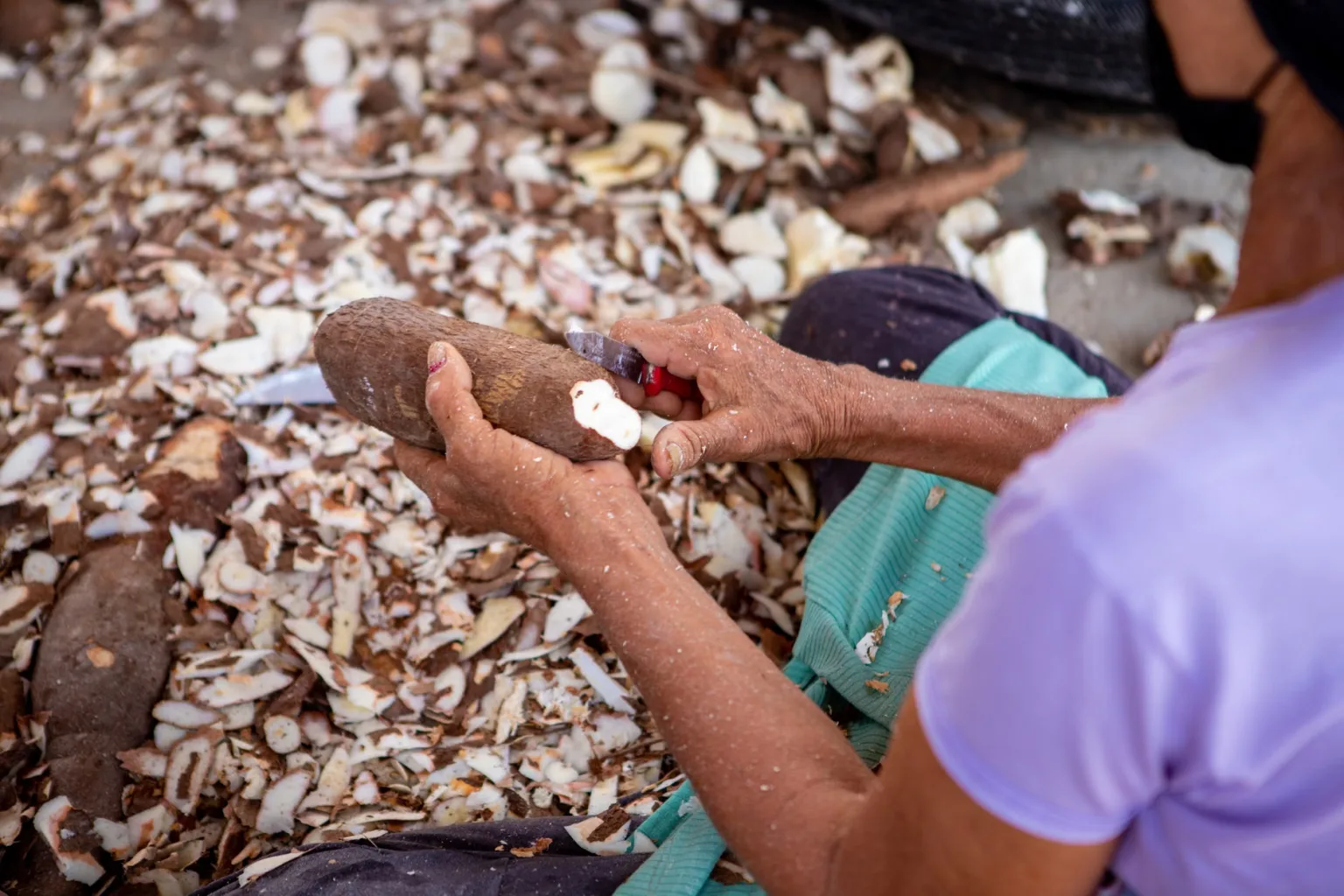
Cassava, also called yuca, is the edible root of Manihot esculenta, a plant in the Euphorbiaceae family. It is sold fresh as a root and may have white or yellowish flesh, depending on the variety. The available description says the flesh is firm, even hard, before cooking and may contain longitudinal fibers. Fresh root is not the same as tapioca: tapioca is a processed cassava product sold, among other forms, as flour or pearls. The sources describe different varieties and preparations, so it is not appropriate to assume every product is prepared in the same way. The peel is described as inedible. The official food-safety excerpt supplied in the evidence package is not readable enough to verify specific preparation instructions.
When to use it
Choose fresh cassava when a recipe calls for a starchy root in a savory dish or specifically names cassava as an ingredient. It can also be used in traditional preparations and as the raw material for processed products. Cassava flour and tapioca have different forms and uses; tapioca, for example, can thicken soups, puddings, or tarts. These products are not straightforward substitutes for fresh root because their form and culinary role differ. Before preparing the root, check that the product is intended for food use and consult reliable guidance that applies to that specific product.
How to use it
Remove the peel and cut the root as the recipe requires; the available description identifies the peel as inedible. Some traditional processes include grating cassava, fermenting the paste, pressing it, and then cooking or drying it. These steps describe particular preparations, not a universally validated method for every variety. Flour and tapioca have other uses: tapioca can thicken soups, puddings, and tarts, while flour is used in foods such as farofa. The supplied evidence package does not provide readable official instructions, cooking times, or temperatures for safely preparing fresh root. Do not infer a safe process from this profile; follow product directions and consult local official guidance.
Flavour and texture
Fresh cassava flesh is described as firm, even hard, before cooking and may contain tougher longitudinal fibers. Depending on the variety, it may be white or yellowish. The available description notes that cut flesh can darken when exposed to air. The sources do not provide a sufficiently consistent description of flavor to promise a particular profile. Final texture depends on preparation and format: fresh root does not behave like flour or tapioca pearls.
How to choose it
Look for a product clearly identified as fresh cassava or yuca and intended for food use. Appearance alone does not establish the variety or the appropriate preparation instructions. The flesh may be white or yellowish, so both colors fit the available description. The sources do not provide reliable criteria for size, blemishes, exterior firmness, or shelf life; avoid relying on unverified selection rules. If the label is unclear or you do not know how to prepare the product, ask the seller or look for specific manufacturer instructions.
Storage
The available sources do not establish storage conditions, temperatures, or time limits for fresh cassava. This profile therefore does not recommend a storage duration or claim that a particular method suits every product. Follow the label and guidance from a local food-safety authority. The flesh may darken after cutting and exposure to air; that described change alone does not establish whether the root is suitable to eat.
Substitutions
Substitution depends on the dish. The sources mention yam or maize as possible bases in some fufu-style preparations; they are not exact equivalents and the texture will change. Tapioca can thicken soups, puddings, or tarts, but it is a processed cassava product and does not directly replace fresh root in every dish. Cassava flour also has a different form and behavior, so replacing it with fresh root requires adapting the preparation.
Common mistakes
Do not treat fresh root, cassava flour, and tapioca as interchangeable formats: their uses and culinary behavior differ. Do not turn steps described for one traditional preparation into universal instructions for every variety. Flesh color alone does not identify the variety or indicate how it should be prepared.
Safety and allergens
The official food-safety excerpt included in the sources is not readable enough to verify a cassava-specific warning or preparation method. This profile therefore gives no times, temperatures, or detoxification process. Follow product instructions and consult local official food-safety guidance before preparing fresh root.
Culinary uses
- Raíz feculenta para guarniciones y platos salados
- Materia prima de harina, tapioca y preparaciones tradicionales
Recommended techniques
- Pelar y cortar según la preparación prevista
- Rallar, fermentar, prensar y cocinar o deshidratar en procesos tradicionales específicos
Pairs well with
- Frijoles y carne de cerdo, como en algunas preparaciones de farofa
- Pescado y leche de coco en preparaciones caribeñas descritas
- Azúcar y vainilla en algunas preparaciones dulces de tapioca
Frequently asked questions
Are cassava and tapioca the same thing?
No. Tapioca is a processed cassava product, available in forms such as flour or pearls, and it has different uses from fresh root.
Is cassava flesh always white?
No. The available description says it may be white or yellowish, depending on the variety.
Why does this guide not give cooking instructions for fresh root?
The supplied official food-safety excerpt is not readable enough to confirm a specific method. Consult official or product-specific guidance before preparing it.
Estimated nutrition
- Fat
- 0.97 g
- Saturates
- 0.97 g
- Carbohydrate
- 33 g
- Sugars
- 0 g
- Fibre
- 1 g
- Protein
- 3.88 g
- Salt
- 0.13 g
Sources and review
Automatically researched, cross-checked and validated content. Sources consulted:
- Client Challenge doi.org
- Aplicaciones de la Biotecnología en Seguridad Alimentaria aesan.gob.es
- Recipe1M+: A Dataset for Learning Cross-Modal ... dspace.mit.edu
- Manihot esculenta - Wikipedia, la enciclopedia libre es.wikipedia.org
- Usos de la mandioca – Botanical-online botanical-online.com
- Tanzania Food Composition Tables | The Nutrition Source nutritionsource.hsph.harvard.edu
- “MANDIOCA BRAVA” IN SOUTHEAST BRAZIL FROM ... revistes.ub.edu
- Cassava Breeding pbea.agron.iastate.edu
- ministry of agriculture and fisheries - AgEcon Search ageconsearch.umn.edu
- CASSAVA AS A FOOD RESOURCE IN BRAZIL publications.dyson.cornell.edu
- UPCommons, UPC's - Universitat Politècnica de Catalunya upcommons.upc.edu
- - YouTube youtube.com
- Mandioca y tapioca: propiedades y usos culinarios - facilisimo.com facilisimo.com

