- Category
- Fish and seafood
- State
- Preserved
- Usual unit
- g
What it is
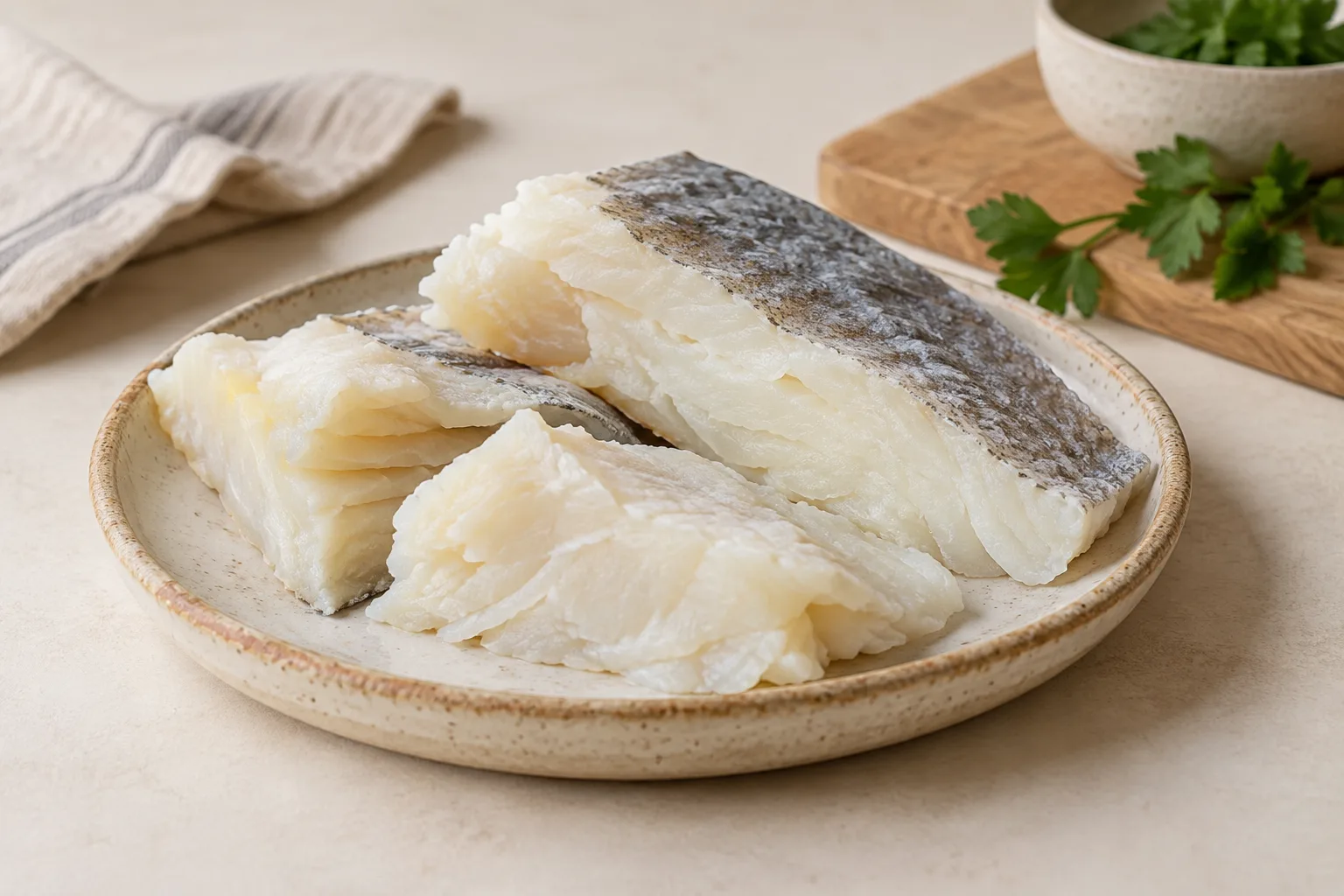
Desalted cod is cod that has first been cured in salt and then processed to remove salt. It is different from fresh cod and from cod sold as lightly salted or salted to taste: that product has not undergone traditional salt-curing. Desalted cod may be sold chilled or deep-frozen. Its firmness, aroma and flavor can vary with the product and cut; it is described as firmer and more pronounced in flavor than lightly salted cod. Check the product name on the label so you know which form you are buying. These distinctions matter when choosing a recipe or adjusting seasoning.
When to use it
Choose desalted cod when you want cod that has already undergone desalting and the product suits the recipe and handling directions on its label. It can take the lead in sauced dishes, stews and baked preparations, or be cooked with oil. Fresh cod and lightly salted cod are not identical alternatives: their processing, flavor and texture differ. If swapping one for another, expect to adapt the seasoning and possibly the cooking approach rather than assuming the result will be the same.
How to use it
Before cooking, check that the label identifies the product as desalted cod, then follow its storage and use directions. Depending on the cut and recipe, cook it in a sauce or stew, bake it, fry it or cook it on a hot surface. A documented pil-pil preparation uses cod with its skin on, olive oil and garlic; gelatin from the skin helps form the sauce as the oil and fish are moved and mixed. Parsley, chickpeas and spinach are also documented companions in cod preparations. Do not add salt automatically: taste the fish and the dish, then adjust seasoning to suit the product and recipe.
Flavour and texture
Desalted cod is described as firmer and more pronounced in aroma and flavor than cod sold lightly salted. Its final saltiness and taste depend on the particular product, so taste before correcting the seasoning. The flesh can flake as it cooks. When present, the skin supplies gelatin used to help make an emulsified pil-pil sauce.
How to choose it
Read the product name and label: desalted cod is distinct from fresh cod and from cod that is only lightly salted. It may be sold chilled or deep-frozen, so check the form and follow the directions for that product. When buying chilled fish, choose a cold product and take perishables home promptly. If a pil-pil recipe calls for skin, check that the cut you select still has it.
Storage
Store desalted cod according to the package directions. Sources describe both chilled and deep-frozen versions, which should not be treated as though they have identical storage requirements. Follow the date and any storage or use instructions on the label. Keep fish separate from other foods to prevent its juices from contacting them, and clean up any spills. A single storage time cannot be stated without knowing the particular product and its label.
Substitutions
Fresh cod may work in some recipes, but it has not been salted and desalted, so its characteristics differ; season carefully. Cod sold lightly salted is another option, although it is not traditionally salt-cured and is described as milder and more tender. Neither substitute guarantees the same flavor or texture as desalted cod, so adapt the recipe to the product you choose.
Common mistakes
Treating desalted cod, fresh cod and lightly salted cod as interchangeable can produce a different flavor and texture from the one expected. Do not assume every form has the same storage instructions; follow its label. Another common mistake is adding salt before tasting, or choosing a skinless cut for a pil-pil sauce that relies on gelatin from the skin.
Safety and allergens
Follow the package storage and use directions, and keep fish separate from other foods to prevent contact with its juices. Cod is fish; check the product’s allergen information if you have a food allergy or intolerance.
Culinary uses
- Ingrediente principal de platos de pescado
- Componente para guisos y preparaciones con salsa
Recommended techniques
- Cocinar suavemente en una salsa
- Confitado, al horno, a la plancha o frito
Pairs well with
- Aceite de oliva, ajo y guindilla
- Perejil, garbanzos y espinacas
Frequently asked questions
Is desalted cod the same as fresh cod?
No. Desalted cod has been salt-cured and then desalted; fresh cod has not undergone that process.
Is it the same as lightly salted cod?
No. The source distinguishes it from a product that has not been traditionally salt-cured and is described as milder and more tender.
How should I store it?
Follow the package directions. Desalted cod may be sold chilled or deep-frozen, so one storage instruction does not apply to every form.
Sources and review
Automatically researched, cross-checked and validated content. Sources consulted:
- En el etiquetado alimentario hay algunas menciones que son obligatorias eletiquetadocuentamucho.aesan.gob.es
- Aesan - Agencia Española de Seguridad Alimentaria y Nutrición aesan.gob.es
- The Essential Glossary of Cooking Terms for the Culinary Arts - Escoffier escoffier.edu
- El Bacalao: Historia, Diseminación Y Usos Culinarios - Restaurante Romero restaurante-romero.es
- Gestión medioambiental de salmueras de desalado de bacalao. Tratamiento mediante tecnología de membranas doi.org
- Food Selection & Storage | Home & Garden Information Center hgic.clemson.edu
- Culinary and Healthy Living - Cabrillo College Extension extension.cabrillo.edu
- Storing White Rice | USU extension.usu.edu
- Home - Culinary Arts / Restaurant Management - LibGuides at Bob Jones University libguides.bju.edu
- Culinary Arts Course Descriptions | Wake Tech waketech.edu
- How to Cook Pork Tenderloin on the Grill • southernwv.edu staging.southernwv.edu
- BACALADILLA PRECIOS SEMANALES EN LA CADENA DE COMERCIALIZACIÓN Campaña 52 mapa.gob.es
- Bacalao en Ajo Blanco 1953 (Cod in White Garlic) - lacocina.utsa.edu
- Basque Recipe: Bakailaoa Pil-pilean | Smithsonian Folklife Festival festival.si.edu
- Bacalao de Noruega II | Library Digital Collections | UC San Diego Library library.ucsd.edu
- 15 Recipes with Desalted Cod: Easy – Bacalalo bacalalo.com
- Grupo Ubago ubagogroup.com
- Bacalao al por mayor para hostelería | Makro makro.es