- Category
- Herbs and spices
- State
- Fresh
- Usual unit
- unit
What it is
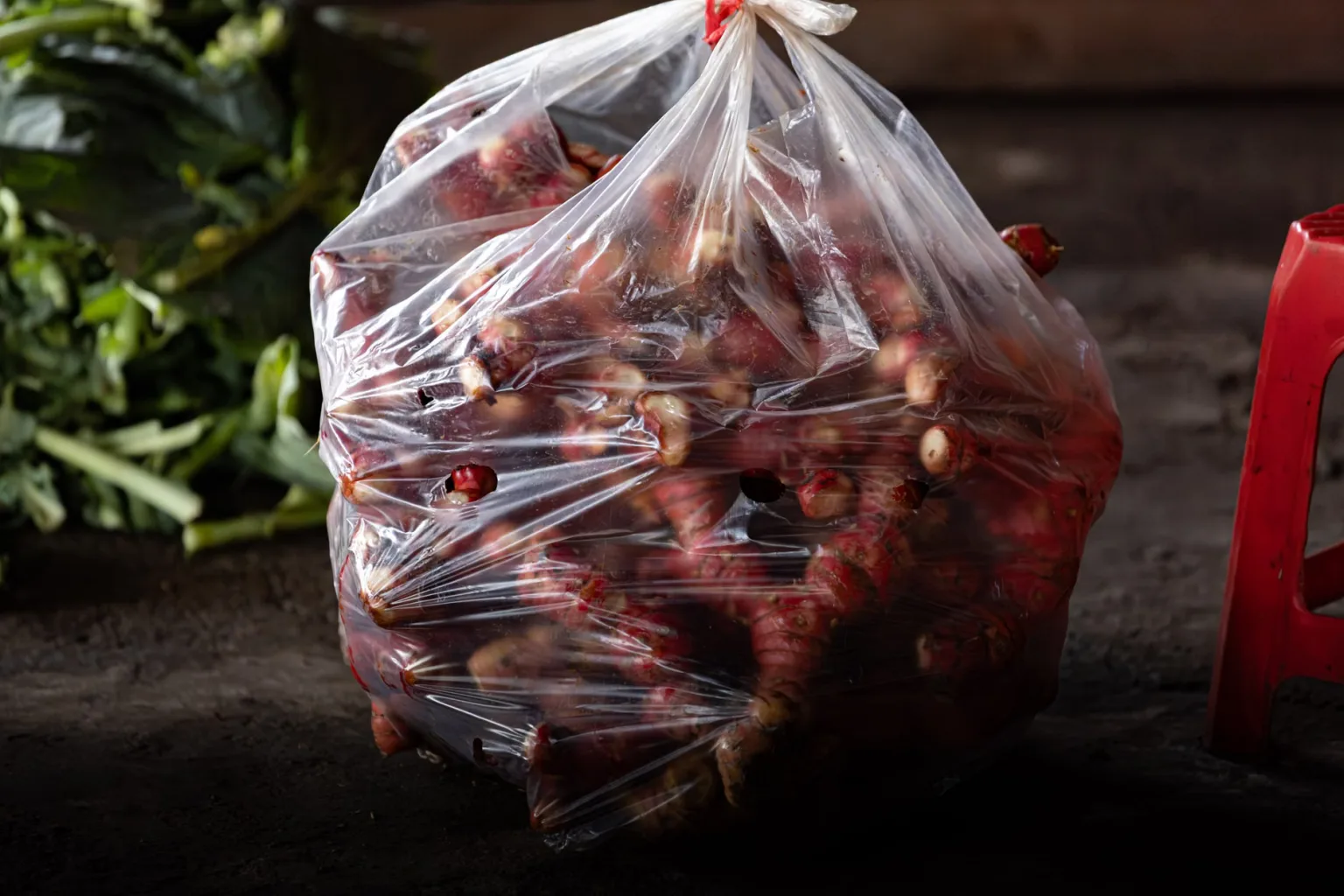
Galangal is the rhizome of plants in the Zingiberaceae family, the same botanical family as ginger, and is used in cooking as an aromatic spice. The name can refer to more than one species; culinary examples include greater and lesser galangal, so aroma and intensity can vary from one product to another. Fresh galangal often looks similar to ginger, though it may have more reddish tones. Its flavor is penetrating and spicy, with notes described as resinous, pine-like, eucalyptus-like or clove-like. It is not simply another form of ginger: it has its own profile and is less lemony. The rhizome is the part most commonly used in cooking and can be peeled, sliced, chopped or crushed to flavor a dish.
When to use it
Use galangal when you want a deep, spicy aroma in a soup, curry, curry paste, stew or marinade. It is useful in dishes inspired by Southeast Asian cooking, where it appears in curries and soups, and it can be paired with lemongrass. Choose fresh galangal when you want to work directly with the rhizome and control the size of the pieces or how thoroughly it is crushed. Keep in mind that there are different galangals and product forms, so results can vary. If a recipe depends on a particular flavor, replacing galangal with ginger will change the dish’s profile.
How to use it
Wash the rhizome to remove any soil. Depending on the preparation, peel its thin outer layer, then slice it, chop it finely or crush it in a mortar to release its aroma. Add it to soups, stews, curries or marinades; it can also be used raw or grated near the end of cooking, depending on the effect you want. Slices or larger pieces can flavor a liquid without finely chopping the rhizome, while chopping or crushing distributes it more through a paste or marinade. If fresh galangal is unavailable, culinary sources describe dried and powdered forms; these do not have the same intensity or texture, so adjust to the recipe and product rather than assuming a fixed conversion.
Flavour and texture
Fresh galangal has a penetrating aroma and a spicy, pungent flavor, with possible resinous notes reminiscent of pine, eucalyptus or clove. Its character differs from ginger, so it should not be treated as an identical substitute. The rhizome is firm and fibrous and is commonly sliced, chopped or crushed for cooking. Aroma and intensity may vary between types and product forms.
How to choose it
Look for a product clearly identified as galangal, and check whether it is fresh, dried or ground because those forms behave differently in a recipe. Fresh galangal resembles ginger and may have reddish tones; do not identify it by color alone. Since the name covers several culinary species, flavor and intensity can vary. If a recipe relies on galangal’s characteristic profile, do not assume that ginger or powdered galangal will produce the same result.
Storage
The available evidence does not establish a storage method or shelf life for fresh galangal. Follow the seller’s or package’s directions for the specific product, and do not apply storage advice for a different form to the fresh rhizome. If you buy dried or powdered galangal, check that product’s label as well: those forms are not equivalent to fresh galangal, and their storage needs should not be assumed to be the same.
Substitutions
Ginger can stand in for galangal when it is unavailable, but this is an approximation rather than a flavor match. Galangal has its own penetrating, resinous profile, and the result depends on the type and form used. Dried or powdered galangal may also be a practical alternative, although it changes the texture and may differ in intensity. Adjust cautiously and treat the substitution as an adaptation of the recipe.
Common mistakes
Do not confuse galangal with ginger or expect a substitution to taste identical: although they are related, their flavor profiles differ. Another common mistake is assuming that every type or form of galangal has the same intensity. Check whether the product is fresh, dried or powdered, and prepare the rhizome for the recipe; slicing, chopping and crushing distribute its aroma differently.
Safety and allergens
Use galangal identified and sold for food, and wash it before preparation. The available culinary sources do not establish medical advice or a universally safe storage method; do not treat traditional uses as health advice, and follow the seller’s or package’s directions.
Culinary uses
- Aromatic rhizome used as a seasoning
- Flavoring for soups, curry pastes, curries, stews and marinades
Recommended techniques
- Peel and slice
- Chop finely
- Crush in a mortar
- Grate or add to a dish near the end of cooking
Pairs well with
- Lemongrass
- Ginger
- Curry pastes and curry blends
- Soups and stews
Frequently asked questions
Is galangal the same as ginger?
No. They are members of the same botanical family, but galangal has its own penetrating, resinous flavor profile. Ginger can be used as a substitute, though the dish will taste different.
How do I prepare fresh galangal?
Wash it and, depending on the recipe, peel its thin outer layer. Then slice, chop, crush in a mortar or grate it for the preparation.
What dishes use galangal?
It is used to flavor soups, curries, curry pastes, stews and marinades. It can also be paired with lemongrass.
Can I replace galangal with ginger?
Yes, as a practical substitute, but it is not an exact match. Ginger contributes a different profile, so the dish will not have precisely the same galangal flavor.
Estimated nutrition
- Fat
- 0 g
- Saturates
- 0 g
- Carbohydrate
- 3 g
- Sugars
- 0 g
- Protein
- 0 g
- Salt
- 0 g
Sources and review
Automatically researched, cross-checked and validated content. Sources consulted:
- The Essential Glossary of Cooking Terms for the Culinary Arts - Escoffier escoffier.edu
- Food Timeline: food history research service libguides.umflint.edu
- A World of Curries | Institute of Culinary Education ice.edu
- A Chat with Leela Punyaratabandhu of SheSimmers.com and "Simple Thai Food" Cookbook Giveaway - Pickles and Tea apa.si.edu
- Why There Are Labor Shortages in Restaurant Kitchens academicworks.cuny.edu
- Cooking up Food Embeddings snap.stanford.edu
- Food, Glorious Food staff.washington.edu
- Tom Yum Near Me Discovering Authentic Recipes and Local Favorites ~ cms.ncwc.edu cms.ncwc.edu
- Galanga | Gastronomía & Cía gastronomiaycia.com
- Comparativa de Galanga Roots: los mejores productos para preparar comida asiática auténtica thaibistro.es
- Galanga, especia en la alimentación – Botanical-online botanical-online.com
- ¿Qué es la galanga? - Guía Vegana, Vegetariana y VegFriendly de Madrid vegmadrid.es