- Category
- Meat
- State
- Preserved
- Usual unit
- slice
What it is
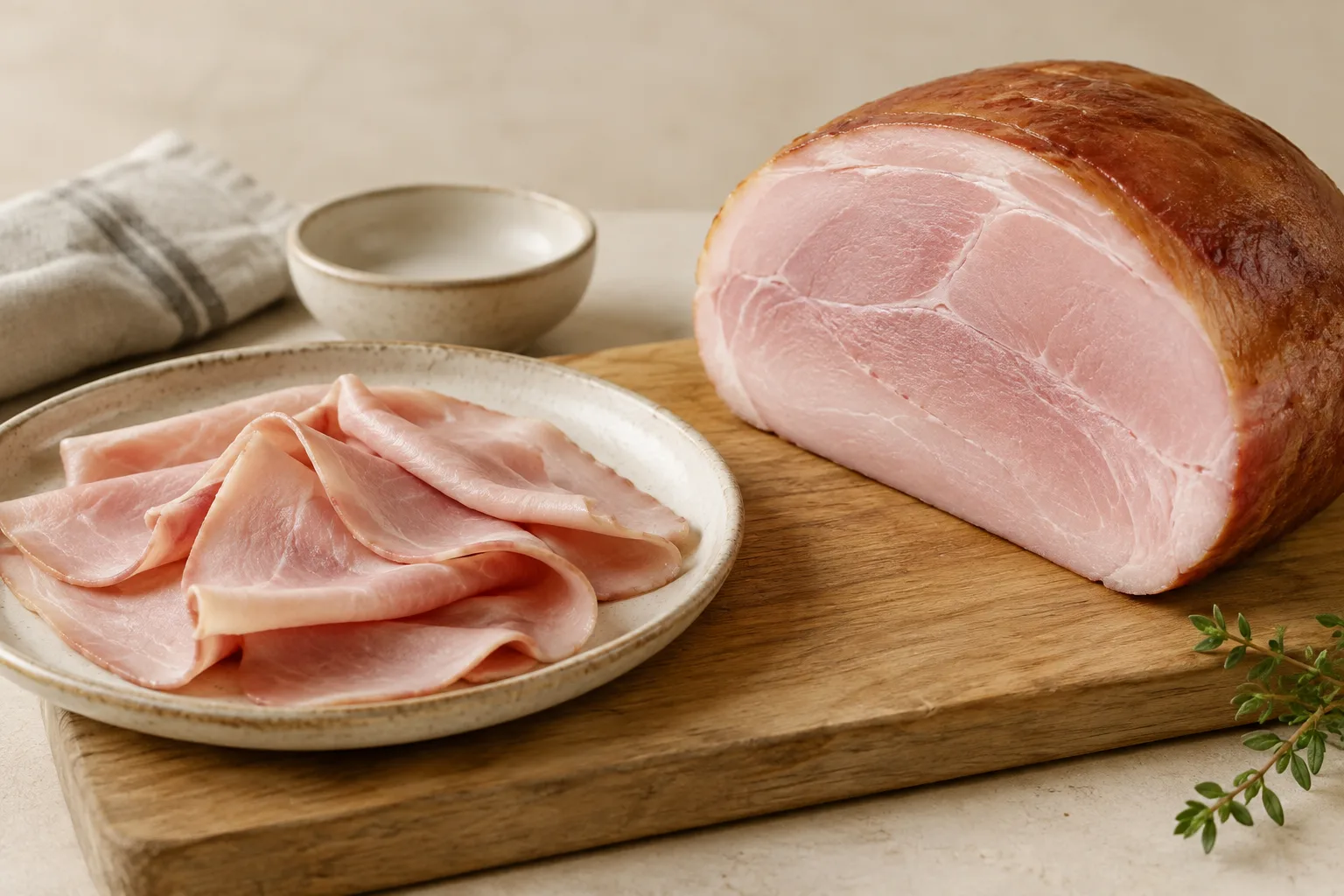
Ham is a name for several pork products, not one uniform preparation. It may be sold cooked, cured, or in other commercial forms, so the word alone does not tell you exactly how it was made or which ingredients it contains. Iberian and Serrano ham are examples of cured ham, whereas cooked ham is a different form. The available culinary source describes salting and curing for Serrano ham as distinct from the process for Iberian ham. To identify the product you have, check its food name, ingredient list, and the maker’s directions. (119, 8023, 12259)
When to use it
Choose ham when you want to add pork to a sandwich, tapa, or savory dish. Thin slices can be served as an appetizer or accompaniment; ham is also used in sandwiches, tapas, and main dishes. Match the product to the result you want: a cured variety can differ from cooked ham, so do not assume they are interchangeable. For a cured Iberian-style product, the culinary source recommends serving the slices at room temperature; do not treat this product-specific advice as a rule for every kind of ham. (8023, 12259)
How to use it
First check the product name and form: packaged slices, cooked ham, and cured ham are not automatically interchangeable. For a simple serving, offer thin slices as an appetizer, tapa, or accompaniment, or use them in a sandwich. You can also add ham to a savory dish as an ingredient, bearing in mind that flavor and texture vary between products. For cured Iberian ham, the culinary source recommends very thin slices and serving at room temperature; apply that advice only when the product is that specific type. Always follow the package’s preparation and storage directions. (119, 8023, 12259)
Flavour and texture
Flavor and texture vary with the type of ham and how it is made. The source describes cured Iberian ham as intense and juicy, and notes its marbled fat; Serrano ham is presented as a different cured variety. Cooked ham should not be assumed to taste or feel the same as cured ham. Thin slices let you serve the product without masking its differences. (8023, 12260, 12259)
How to choose it
Read the food name and ingredient list to find out whether you are buying cooked ham, cured ham, or another form. Compare the specific product label rather than inferring its variety, origin, or production method from the word “ham” alone. For packaged products, also check the date, storage directions, and allergen information; required information can depend on how a product is presented and sold. (119)
Storage
There is no single storage direction that applies to every form of ham. Follow the instructions on the package, including any special storage conditions and the product date. If it is sold unpackaged, ask the seller how to store it and where to find allergen information. Do not assume cured and cooked ham can be stored in the same way without checking the label. (119)
Substitutions
Use another cured ham when a recipe relies on the flavor and texture of a cured product; prosciutto may suit the dish. For a recipe calling for mild cooked slices, choose another cooked ham with a similar profile. Varieties are not identical, so adjust the amount and serving style to suit the result you want. (8023, 12259)
Common mistakes
Do not treat every ham as the same product: cooked, Serrano, and cured Iberian ham can differ in production, flavor, and texture. Do not assign a particular origin, breed, or animal diet to a product without checking its label. Nor should the advice to serve cured Iberian ham at room temperature be applied to all ham. (119, 8023, 12260)
Safety and allergens
Check the label and follow the maker’s directions for date, storage, and use. Allergen information can vary with ingredients and presentation; if you buy unpackaged ham, ask the seller for that information. (119)
Culinary uses
- sliced serving ingredient
- sandwich and tapa filling
- savory dish ingredient
Recommended techniques
- slice thinly for serving
- serve as a topping or filling
Pairs well with
- bread
- melon
- aged Manchego-style cheese
Frequently asked questions
Is all ham cured?
No. The name covers different forms, including cooked ham and cured ham. Check the product name on the label. (119, 12259)
How is ham commonly served?
It can be served in slices as an appetizer, tapa, or accompaniment, or used in sandwiches and savory dishes. (12259)
How should I store ham?
Follow the storage directions and date on the label of the specific product. (119)
Estimated nutrition
- Fat
- 2.68 g
- Saturates
- 0 g
- Carbohydrate
- 7.14 g
- Sugars
- 5.36 g
- Protein
- 16.1 g
- Salt
- 2.23 g
Sources and review
Automatically researched, cross-checked and validated content. Sources consulted:
- En el etiquetado alimentario hay algunas menciones que son obligatorias eletiquetadocuentamucho.aesan.gob.es
- Client Challenge doi.org
- The Essential Glossary of Cooking Terms for the Culinary Arts - Escoffier escoffier.edu
- Spain’s Prized Ham: Jamón Ibérico | Institute of Culinary Education ice.edu
- Agencia Española de Seguridad Alimentaria y Nutrición aesan.gob.es
- Nutrition After Your Transplant - Health Online healthonline.washington.edu
- Holiday Meats—Not Just Turkey! | Home & Garden Information Center hgic.clemson.edu
- Alumni in the News: May 2026 | Culinary Institute of America ciachef.edu
- The Pata Negra and Catholic Dominance in Spain berkleycenter.georgetown.edu
- Guest demonstration with José Sol cordonbleu.edu
- Why Every Foodie’s Pantry Needs Authentic Jamón Ibérico—Experts Weigh In! - MBL.edu seabase.core.cli.mbl.edu
- Jamón Ibérico en la Cocina Internacional | Blog Alba Romero jamonalbaromero.com
- El jamón ibérico en la gastronomía fusión: combinando tradiciones - Jamón Puro Bellota jamonpurobellota.com
- El fascinante mundo del jamón: historia, variedades y proceso de elaboración. - Embutidos Escámez embutidosescamez.com
- Jamones de Gastronomic Spain: Calidad y sabor español gastronomicspain.com