- Category
- Sauces and condiments
- State
- Paste
- Usual unit
- ml
What it is
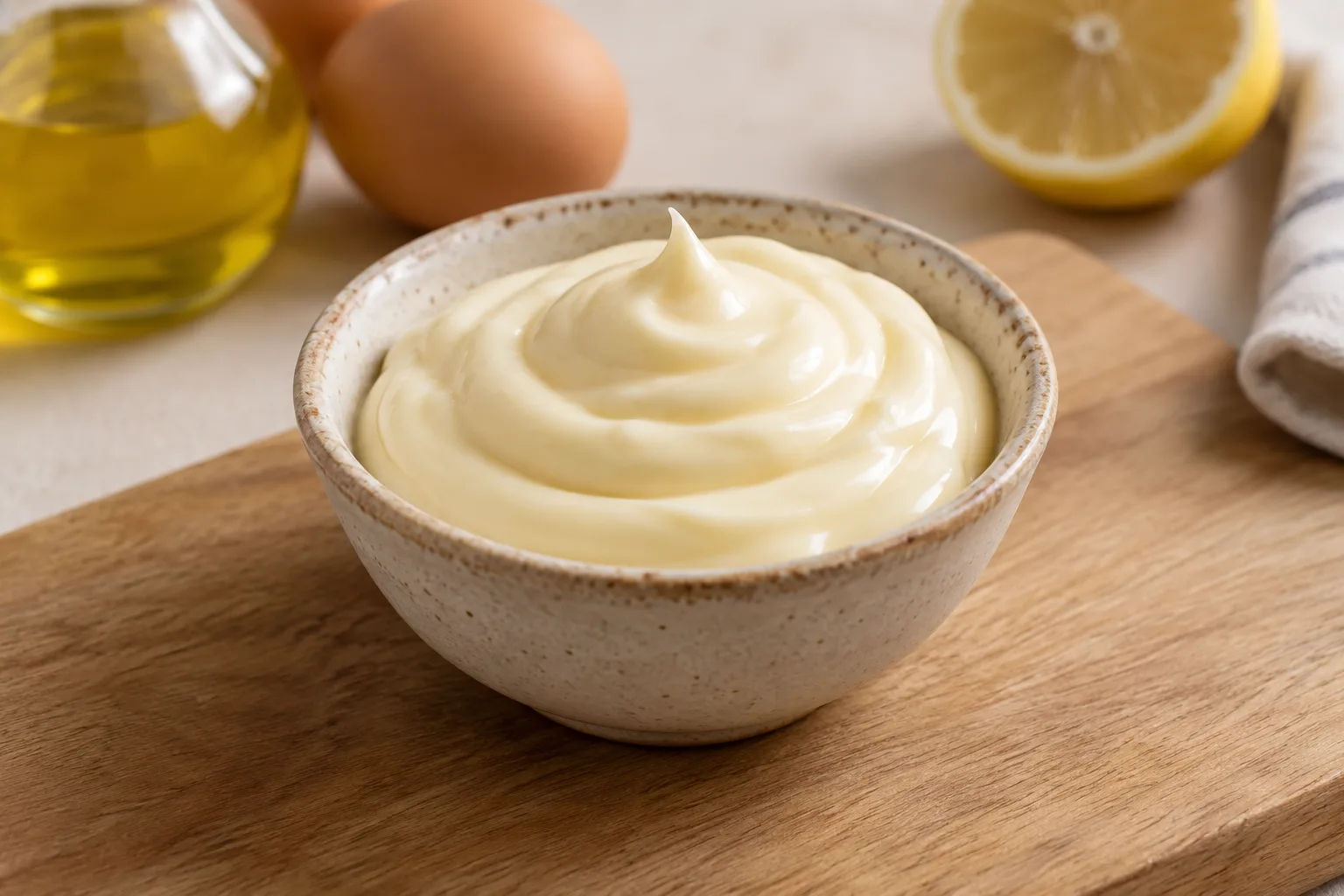
Mayonnaise is an emulsified sauce: in its traditional form, oil is dispersed through a mixture containing egg and an acidic ingredient such as vinegar or lemon juice. The result is usually smooth and creamy, with a consistency suited to spreading or mixing. Salt and other seasonings may be added, and commercial formulas can contain additional ingredients. Not every version is the same: plant-based products and other variations exist, so the name alone does not reveal the full ingredient list. The sauce’s historical origins are disputed and are not needed to understand its kitchen uses. Check the ingredients and allergen information for the specific product, especially if you need to avoid egg.
When to use it
Use mayonnaise when you want creaminess, a mild flavor with some acidity, or a texture that helps ingredients hold together. It works as a spread or accompaniment in sandwiches and can be mixed into potato, coleslaw, or chicken salads. It can also serve as a starting point for other sauces when combined with additional ingredients. It pairs with vegetables, fish, and seafood, although the result depends on the mayonnaise and the other flavors in the dish. If you need an egg-free option, do not assume any mayonnaise will suit you: check the label and choose an appropriate plant-based version.
How to use it
Use mayonnaise straight as a condiment or spread, or mix it with other ingredients to make a sauce or dressing. For salads, add it gradually until the ingredients are coated and held together, without using more than needed. To make a traditional homemade version, beat egg or yolk while gradually incorporating oil; vinegar or lemon juice provides acidity, and salt seasons the mixture. Continuous beating and a gradual addition of oil help form the emulsion. Adjust the flavor by mixing in herbs, garlic, or other seasonings, and serve with vegetables, fish, seafood, or sandwiches. Follow the package directions when using a commercial product.
Flavour and texture
Its profile is generally mild, creamy, and slightly tangy; the exact flavor changes with the oil, acid, seasonings, and formula. The consistency can range from rich and thick to somewhat lighter. Homemade, commercial, and plant-based versions may differ in color, flavor, and texture. Mayonnaise adds a creamy layer, but its flavor is not identical across all versions.
How to choose it
Read the product name and ingredient list to distinguish a traditional formula from a plant-based product or another variation. Check allergen information too, especially if you need to avoid egg: recipes are not uniform, and the product name alone does not guarantee a particular composition. Review the storage and use directions for that package. Choose a texture and flavor profile that suits the dish, bearing in mind that the oil and seasonings can change the result.
Storage
Follow the storage and use directions on the package; recommendations can differ by formula and presentation. Food-label information may state special storage or use conditions where applicable. Do not assume that commercial mayonnaise and a homemade preparation have the same directions or storage life. If the package is unavailable, a safe storage period for that specific product cannot be established here.
Substitutions
For an alternative without animal-derived ingredients, look for plant-based or vegan mayonnaise and verify its ingredient list and allergen information; available formulas vary. Aioli can fill a similar role as a creamy sauce, but it has a different flavor profile and should not be treated as an exact equivalent. A substitution may change the taste, texture, and composition of the dish.
Common mistakes
Do not assume every mayonnaise has the same ingredients or that every version is suitable when avoiding egg. Another common mistake is adding too much to a salad before mixing and checking the texture. In a homemade preparation, adding oil without doing so gradually while beating continuously can make emulsification harder. Do not ignore the package’s storage directions.
Safety and allergens
Check the label for ingredients and allergens, and follow the product’s storage and use directions. Some versions contain egg while others have different formulas; if you need to avoid an allergen, verify the information for the specific product. No single official storage instruction for every mayonnaise or homemade preparation is available here.
Culinary uses
- condimento para untar y acompañar
- base cremosa para otras salsas y aliños
- ingrediente aglutinante en ensaladas y rellenos
Recommended techniques
- mezclar o batir para incorporar otros ingredientes
- emulsionar: añadir el aceite gradualmente mientras se bate, en preparaciones caseras
Pairs well with
- sándwiches y bocadillos
- ensaladas de patata, col o pollo
- verduras y pescados
- mariscos
Frequently asked questions
Does mayonnaise always contain egg?
Not necessarily. Many traditional formulas contain egg, but plant-based versions exist and commercial recipes vary. Check the ingredient list and allergen information for the specific product.
What does mayonnaise add to a salad?
It adds a creamy texture and can help bind the ingredients. Add it gradually to control the consistency and flavor.
How is traditional homemade mayonnaise made?
Egg or yolk is emulsified with oil by beating while the oil is added gradually. Vinegar or lemon juice and salt may also be used; formulas and proportions vary.
Estimated nutrition
- Fat
- 78.6 g
- Saturates
- 10.7 g
- Carbohydrate
- 0 g
- Sugars
- 0 g
- Protein
- 0 g
- Salt
- 1.78 g
Sources and review
Automatically researched, cross-checked and validated content. Sources consulted:
- En el etiquetado alimentario hay algunas menciones que son obligatorias eletiquetadocuentamucho.aesan.gob.es
- Client Challenge doi.org
- Ensaladilla de Albacete: La Estrella de los Aperitivos con Sabor y Variedad albacetecapital.es
- Aesan - Agencia Española de Seguridad Alimentaria y Nutrición aesan.gob.es
- Mayonesa - Wikipedia, la enciclopedia libre es.wikipedia.org
- Cómo la mayonesa puede transformar tus platos favoritos friolisa.es
- Mayonesa: Historia, Recetas Y Usos – Alimentacion Sana alimentacion-sana.org
- Mayonesa o mahonesa, una o mil tipos - Mercado de Chamartín mercadodechamartin.es
- Mayonesa | www.cocinista.es cocinista.es
- La mayonesa: origen y variantes | Yo como bien yocomobien.es
- La Fascinante Historia de la Mayonesa: Orígenes, Curiosidades y Recetas Inolvidables - Descubre el Significado de las Cosas descubria.com
- Explorando los diferentes tipos de mayonesa y en qué se diferencian - SaintyCo saintyco.com
- Mayonesa para Niños ninos.kiddle.co
- Mayonesa: el papel del aceite de oliva en su sabor único | Magefesa magefesa.com
- Maridajes suaves y cremosos. Los mejores vinos para mayonesa catatu.es
- La mejor receta de mayonesa casera y ocho originales variantes para dar más sabor al picoteo del finde trendencias.com
- Jamón serrano y Mayonesa: la mezcla que conquista sabor y textura únicos elconfidencialdigital.com