- Category
- Herbs and spices
- State
- Dry
- Usual unit
- teaspoon
What it is
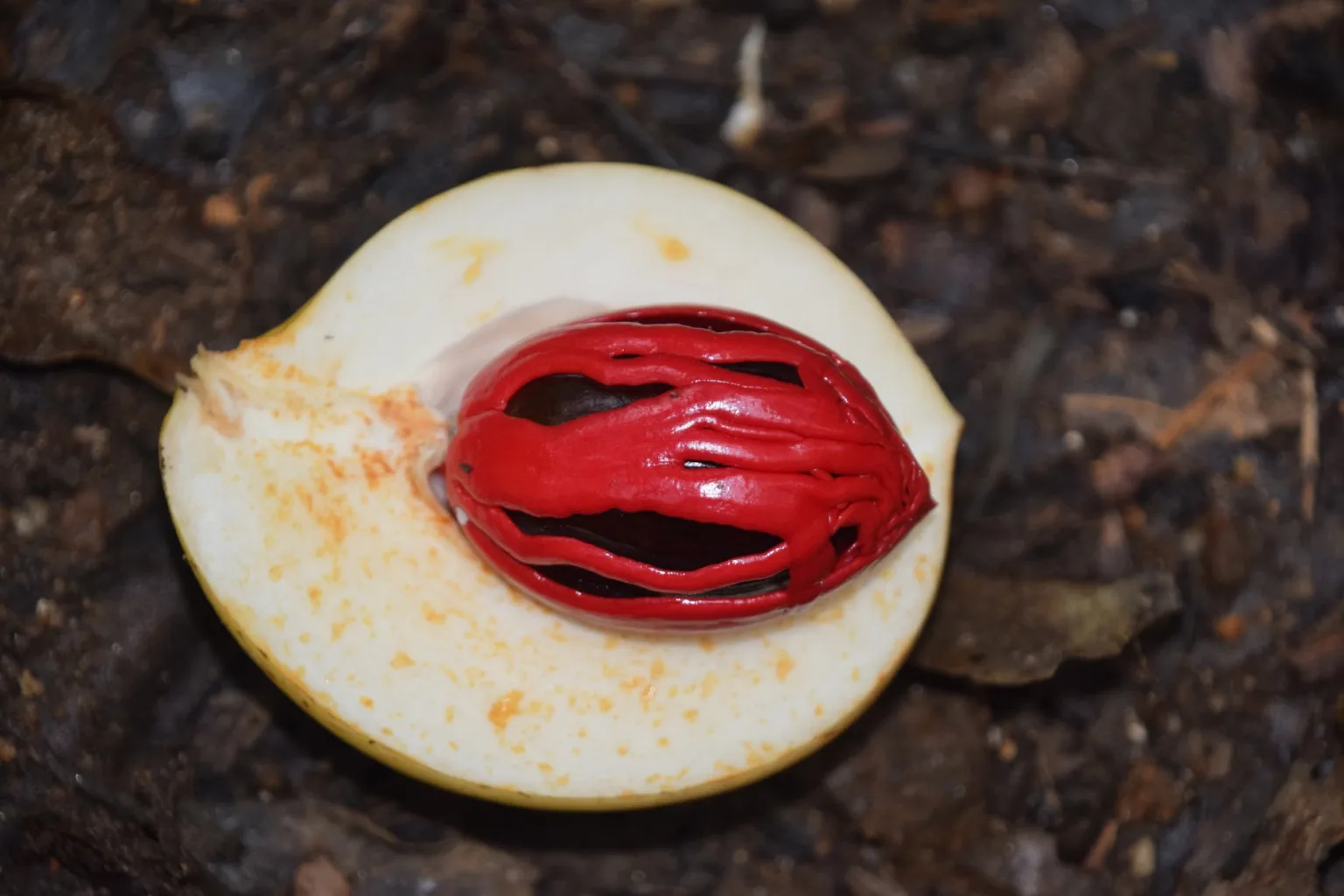
Nutmeg is the aromatic seed of the tree Myristica fragrans. Despite the word “nut” in its name, it is a seed rather than a tree nut. The seed is covered by a reddish outer layer called mace, which is sold as a separate spice. Nutmeg is commonly available whole, dried, or ground. The whole seed is hard and must be grated for use; the ground form can be sprinkled or mixed straight into a recipe. Its warm, pronounced aroma means that a small amount can noticeably perfume a dish. Nutmeg and mace come from the same fruit, but they are distinct ingredients and should not be treated as identical in flavor.
When to use it
Use nutmeg when you want a warm, spiced aroma without changing a dish’s structure. It is especially suited to creamy white sauces, potato purée, cooked vegetables, gratins, and other preparations with dairy ingredients. It can also be added to custards, baking mixtures, desserts with cooked fruit, and hot drinks. In delicate recipes, begin with a small amount so the spice supports rather than overwhelms the other flavors. Whole nutmeg is useful when you want to grate it just before adding it; ground nutmeg is convenient when you want to mix it in quickly and evenly.
How to use it
If using whole nutmeg, grate it directly over the dish with a fine grater and stir to distribute the aroma. You can also grate the amount needed before adding it to a sauce, purée, batter, or hot drink. Ground nutmeg can be sprinkled over a dish or combined with the other dry ingredients, depending on the recipe. Start with a small amount and taste before adding more: its flavor is pronounced and can easily stand out. In savory cooking, try it in creamy sauces, vegetables, purées, and gratins. In sweet recipes, it can flavor cookies, cakes, custards, and mixtures containing fruit. It pairs well with warm spices, but you do not need to add several spices if you want nutmeg’s aroma to remain distinct.
Flavour and texture
Nutmeg’s aroma is described as warm, sweet, resinous, and slightly camphor-like, with woody notes. Its flavor is intense and lingering, but it is not usually described as hot or chili-like. Whole nutmeg is hard and needs grating; once grated, it can be stirred into food. Ground nutmeg has a fine texture and mixes readily. Because its aromatic profile is pronounced, add it gradually and taste the dish before increasing the amount.
How to choose it
Nutmeg is available whole or ground; both formats can be used in similar dishes, but they offer different levels of convenience. Choose whole nutmeg if you want to grate it directly over food, and ground nutmeg if you prefer to add it without grating. Check the label to confirm the format and make sure you are buying nutmeg rather than mace. The supplied evidence does not support a recommended place of origin, buying season, or specific visual quality test.
Storage
Keep nutmeg in a clean, tightly closed container and follow the product label. Protect it from moisture and from strong odors that could transfer to the spice. Whole nutmeg can be grated as needed; ground nutmeg is ready to use. The available evidence does not establish a shelf life or more specific storage conditions, so follow the label and check the aroma before cooking.
Substitutions
Mace, the layer around the seed, is related to nutmeg but has a different flavor profile; it can stand in when you are comfortable with that difference, and it is best used sparingly. You can also substitute one nutmeg format for the other: grate whole nutmeg if you do not have ground nutmeg, or use ground nutmeg if you do not have a whole seed to grate. This changes the texture and method of adding the spice, but not its identity.
Common mistakes
Too much nutmeg can make its pronounced aroma dominate the other ingredients. Start with a small amount and taste before adding more. Another mistake is treating mace as exactly the same product: it comes from the seed’s outer covering and has its own flavor profile. Also, remember that whole nutmeg must be grated before it can be added to a dish.
Safety and allergens
Use nutmeg as a culinary seasoning and follow the product directions. The supplied evidence contains no specific official safety warning that would support more detailed safety advice.
Culinary uses
- Aromatic seasoning for savory dishes
- Warm spice for sweet dishes and drinks
Recommended techniques
- Grate whole nutmeg directly into a dish
- Stir a small amount of ground nutmeg into sauces, purées, batters, or drinks
Pairs well with
- Milk, cream, and other dairy ingredients
- Potato, spinach, cauliflower, pumpkin, and other vegetables
- Cinnamon, clove, ginger, cardamom, and vanilla
Frequently asked questions
Is nutmeg a tree nut?
No. It is the seed inside the fruit of Myristica fragrans. Mace is the layer around that seed and is sold as a separate spice.
Should I buy whole or ground nutmeg?
Whole nutmeg can be grated as needed; ground nutmeg is more convenient to add and mix.
What kinds of dishes use nutmeg?
It works in creamy sauces, purées, vegetables, gratins, desserts, baking, and hot drinks.
Estimated nutrition
- Fat
- 45.4 g
- Saturates
- 26 g
- Carbohydrate
- 45.4 g
- Sugars
- 0 g
- Fibre
- 45.5 g
- Protein
- 0 g
- Salt
- 0 g
Sources and review
Automatically researched, cross-checked and validated content. Sources consulted:
- Client Challenge doi.org
- The Essential Glossary of Cooking Terms for the Culinary Arts - Escoffier escoffier.edu
- Vamos a Conservar Alimentos: Rellenos de fruta para tartas, tortas y pasteles extension.psu.edu
- Informe de resultados del estudio prospectivo para la ... aesan.gob.es
- Seasonal Produce Handouts | UNL Food | Nebraska food.unl.edu
- NUTRITION IN ME 4th GRADE Curriculum - Wsu s3.wp.wsu.edu
- Development of the Spanish Healthy Food Reference Budget for ... dau.url.edu
- Dispersal of a Neotropical Nutmeg (virola Sebifera) by Birds digitalcommons.usf.edu
- Nuez moscada: qué es, propiedades, peligros y usos en la cocina bonviveur.com
- ¿Cómo usar la nuez moscada dentro y fuera de tu cocina? magenis.es
- Nuez moscada: usos, sabor y formatos para venderla. | Alveus alveus.eu
- La Nuez Moscada: Origen, Historia, Producción, Usos Y Propiedades - Restaurante Romero restaurante-romero.es
- Nuez moscada y macis, las especias reinas de mi cocina. Apuntes - Cocina y Aficiones cocinayaficiones.com