- Category
- Vegetables
- State
- Fresh
- Usual unit
- g
What it is
Round green beans are the tender pods of a legume plant, eaten whole while still green rather than as dried seeds. “Round” describes the pod’s cylindrical cross-section, in contrast to flat-podded varieties; it does not mean they are an entirely separate culinary species. In cooking, they are treated as a vegetable, although botanically they belong to the legume family. Varieties can differ in color, size and shape, and pods can vary in firmness and tenderness. This profile is about fresh green beans, not dried beans or preserved products.
When to use it
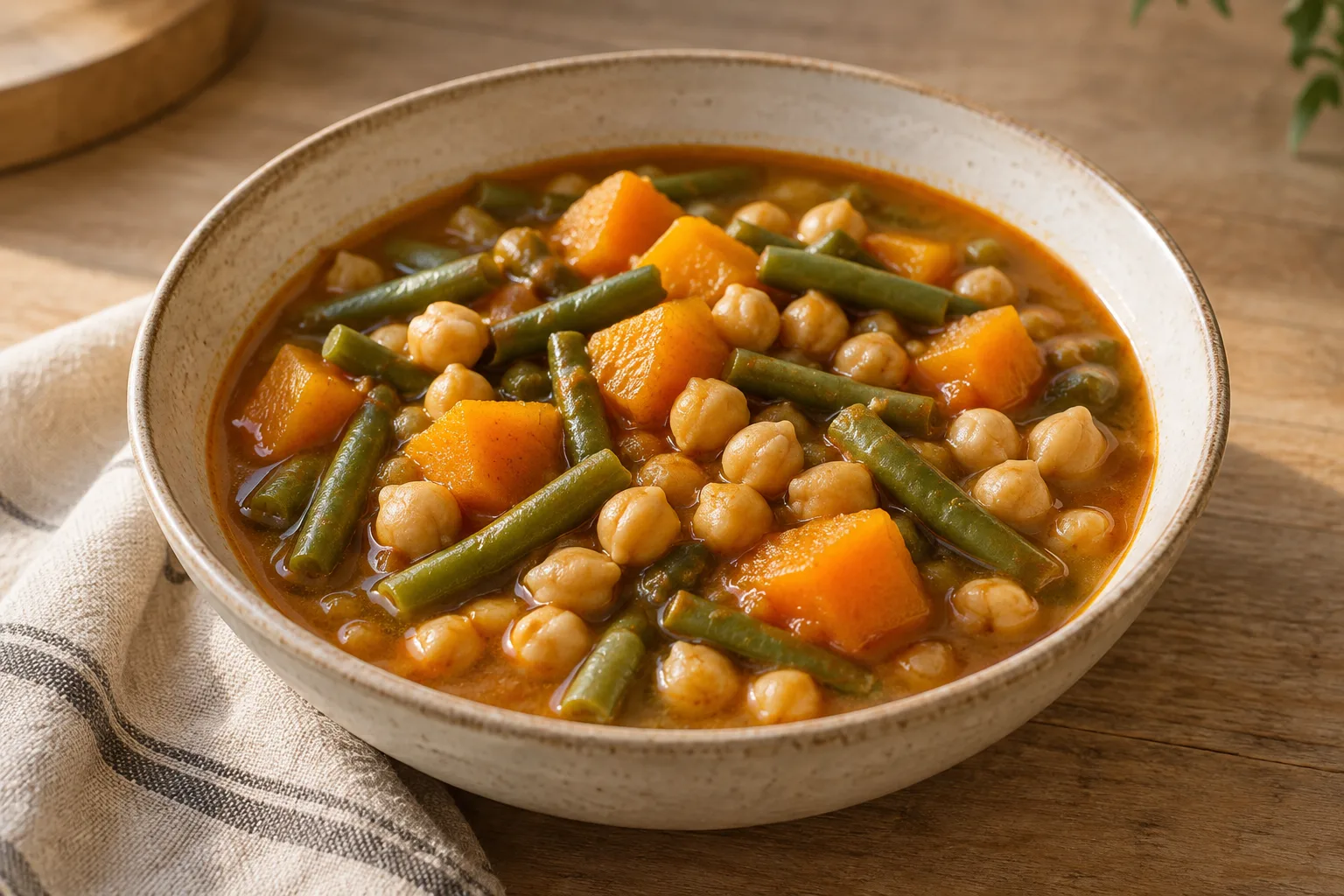
Use them when you want a mild-tasting vegetable that keeps a recognizable shape on the plate. Round pods work well as a side dish, in warm or cold salads, stir-fries and mixed vegetable dishes. They can also be added to soups and stews or blended into a creamy soup. Sources distinguish round from flat varieties by shape and texture, but do not give a precise month-by-month season for the round type. Choose according to the quality available and the texture you want rather than assuming a particular season.
How to use it
Trim the ends if desired, wash the pods and cut them to suit the dish. Boil or steam them for a side dish, cool them after cooking for a salad, or sauté them with other ingredients. They can also be used in baked dishes, stews and purées. For a salad, let the beans cool and drain them before dressing. In a stir-fry, pair them with ingredients such as garlic, onion or tomato. Choose the final texture to suit your preference: sources describe several preparations but do not establish one cooking time that applies to every size and variety.
Flavour and texture
Their flavor is generally mild and may have a slight sweetness. Round beans are described as firm and somewhat crisp, though variety and freshness can change the result. A shorter cook can preserve more firmness, while longer cooking makes them more tender. These are general characteristics, not a guarantee for every pod: size, maturity and variety influence texture and perceived flavor.
How to choose it
Look for pods with a vivid, bright appearance, an even shape and no unusual discoloration. They should feel firm rather than limp or soft; pods that are excessively hard or fibrous may have passed their most tender stage. Very prominent seeds can also indicate a more developed pod. Choose fresh-looking, intact pods, and do not rely on length alone because characteristics vary by variety.
Storage
Keep fresh green beans refrigerated, preferably in a perforated bag. One produce guide gives an approximate storage span of five to ten days, although the beans’ condition when purchased and storage conditions affect how long they keep. Check them before use and discard any with obvious deterioration. If freezing them, a culinary source recommends blanching first; use a reliable procedure and follow the directions for the appliance or container you use.
Substitutions
Flat green beans can replace round ones in many recipes, although the shape and texture will not be exactly the same. Frozen green beans are another option when fresh ones are unavailable; preparation may differ by product, so follow the package directions. Neither substitute guarantees the same cooking time or result.
Common mistakes
If you want a firm texture, avoid choosing limp or soft pods, and do not assume every green bean needs the same degree of cooking. Drain them before adding them to a salad so excess water does not end up in the dressing. Do not confuse the tender pods in this profile with dried beans, which are a different product state and are used differently.
Safety and allergens
This profile covers fresh green beans and does not provide canning instructions. Low-acid vegetable preserves, including green beans, have been associated with botulinum toxin. For packaged products, follow the storage and use directions on the label; do not use this profile as a guide to home canning.
Culinary uses
- Guarnición de verduras
- Ingrediente para ensaladas, salteados y platos de verduras
Recommended techniques
- Hervir o cocinar al vapor
- Saltear
- Asar al horno
- Incorporar a guisos o triturar para preparar una crema
Pairs well with
- Patata
- Tomate y cebolla
- Ajo
- Anchoas, queso o nueces
Frequently asked questions
Are green beans vegetables or legumes?
They are used as a vegetable in cooking because they are eaten young with the pod, but botanically they belong to the legume family.
Can I use flat green beans instead of round ones?
Yes. Culinary sources describe the two shapes as interchangeable in many recipes, although the dish’s shape and texture may differ.
How can I cook round green beans?
They can be boiled, steamed, sautéed or roasted, and used in salads, stews and purées. Choose a method to suit the dish and the texture you want.
Estimated nutrition
- Fat
- 0.22 g
- Saturates
- 0.05 g
- Carbohydrate
- 6.97 g
- Sugars
- 3.26 g
- Fibre
- 2.7 g
- Protein
- 1.83 g
- Salt
- 0.02 g
Sources and review
Automatically researched, cross-checked and validated content. Sources consulted:
- En el etiquetado alimentario hay algunas menciones que son obligatorias eletiquetadocuentamucho.aesan.gob.es
- Aesan - Agencia Española de Seguridad Alimentaria y Nutrición aesan.gob.es
- Client Challenge doi.org
- Paella - Wikipedia, la enciclopedia libre es.wikipedia.org
- Judía verde: origen, cultivo, propiedades y beneficios. frutamerca.com
- Conoce las judías verdes, sus caracteristicas y como cocinarlas con 5 recetas cocinayaficiones.com
- 10 recetas con judías verdes, sanas y fáciles | Gastronosfera gastronosfera.com
- Propiedades y beneficios de las judías verdes - Verleal verleal.com
- Judías verdes | Introducción | Verduras y hortalizas | EROSKI CONSUMER verduras.consumer.es
- Judías verdes salteadas: receta de primer plato o guarnición conasi.eu
- Las mejores recetas con judías verdes directoalpaladar.com
- Judías verdes: cómo conservarlas y cuántas variedades hay abc.es
- Productosluque.es - Cocina práctica, recetas y organización del hogar productosluque.es
- Judias verdes - Infoalimenta infoalimenta.com
- Recetas irresistibles con judías verdes redondas que debes probar cookpad.com
- Judía verde (kg) - Agricultores en Origen agricultoresenorigen.com
- Cómo conseguir que las judías verdes queden tiernas y sabrosas: 15 recetas rápidas y llenas de sabor hola.com
- Receta de judías verdes redondas a la inglesa | Findus findus.es