- Category
- Herbs and spices
- State
- Fresh
- Usual unit
- unit
What it is
Holy basil is an aromatic herb also known as tulsi and, in Thai cooking, as kaprao or bai kaprao. It is identified by the botanical name Ocimum tenuiflorum; another supplied source also gives Ocimum sanctum as a name for the plant. It is not the same herb as Thai sweet basil or common sweet basil, although these are related culinary herbs. Holy basil may be found in forms with purple, green, or mixed leaves and stems. These forms do not necessarily have the same aroma, so the character of a dish can change depending on which one is used. The fresh leaves are used in cooked dishes and can also be eaten raw or made into an infusion.
When to use it
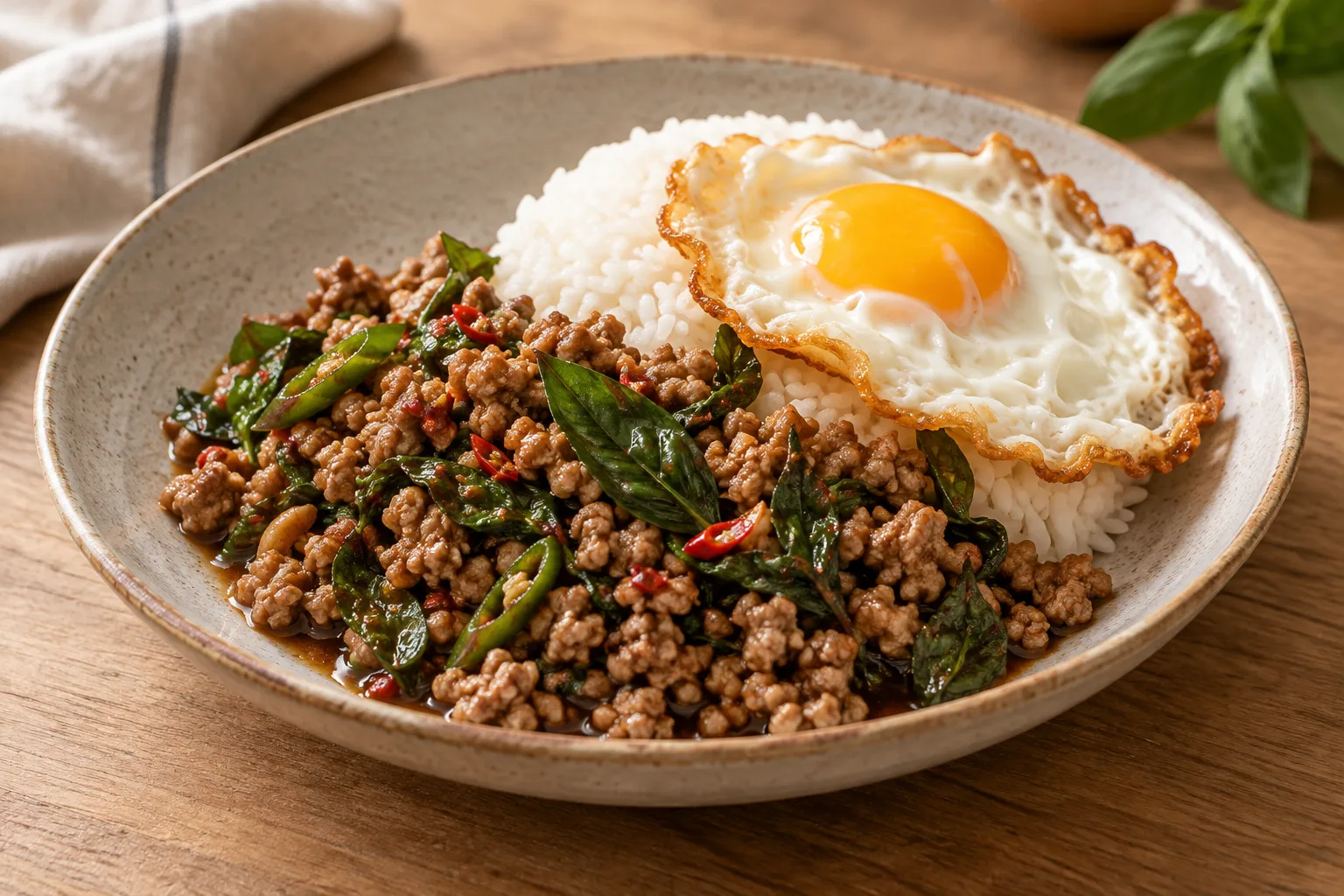
Choose holy basil when you want a herbal, spicy aromatic note, especially in Thai-inspired stir-fries. It is a familiar ingredient in pad kaprao, a dish described with its leaves and meat or seafood. The herb can also go into sauces, soups, curries, and other stir-fries; use it raw when you want its aromatic presence to remain distinct and uncooked. Intensity can differ among red, green, and mixed forms, so consider the type available and the flavor you want. Do not confuse it with Thai sweet basil, which has a different aromatic profile.
How to use it
Separate the leaves from the stems and add them raw, whole, or chopped to a salad or as a finishing touch when you want a fresh herbal presence. You can also use them in cooked preparations: the supplied sources describe holy basil in sauces, soups, curries, and stir-fries, including pad kaprao with meat or seafood. In a stir-fry, use it as the aromatic herb and adjust to the strength of the leaves you have, since intensity can differ by type. The leaves can also be steeped in water for an infusion. The evidence supplied does not establish cooking times, temperatures, or proportions; follow your recipe and do not assume holy basil behaves exactly like sweet basil.
Flavour and texture
Its profile is described as aromatic and spicy, with notes that may suggest clove, licorice, or mint. Descriptions vary, and not every plant or variety has the same intensity: red forms are described as more aromatic than white ones, while mixed forms fall between them. Thai sweet basil, by contrast, is associated with sweet, anise-like notes. Fresh leaves bring a herbal presence; the supplied evidence does not specify a texture beyond their leaf form.
How to choose it
Look for holy basil, tulsi, or kaprao on the label to distinguish it from Thai sweet basil and other basils. If the variety is stated, red, green, or mixed forms can help indicate appearance and aromatic intensity: the supplied descriptions characterize red forms as generally more aromatic and white forms as less aromatic. Since intensity varies, choose according to the aroma you want and the recipe. The evidence provided does not establish visual freshness criteria or quality standards.
Storage
The available evidence does not specify a storage method, temperature, or shelf life for fresh holy basil. To avoid inventing instructions, follow the seller's or package's directions and use it while it remains within the stated conditions. Do not assume guidance for other basil varieties applies. If the product is dried or sold in another form, follow that specific label, since this profile focuses primarily on fresh herb.
Substitutions
Thai sweet basil or common sweet basil can be approximate alternatives if holy basil is unavailable, but they are not exact equivalents: the supplied sources describe different aromatic profiles. Thai sweet basil may contribute anise-like notes, while holy basil is associated with spicy, clove, licorice, or mint-like nuances. Choose according to the character you want in the dish, and do not expect to reproduce the exact flavor of a traditional pad kaprao.
Common mistakes
A common mistake is treating holy basil and Thai sweet basil as the same ingredient: the sources identify them as different herbs with different aromas. It is also unwise to assume every holy basil variety has the same intensity, since the described forms differ. Finally, do not treat a culinary ingredient as medicine or use it instead of medical care; this profile is limited to culinary uses supported by the sources.
Safety and allergens
Use the product as food and follow the package or seller instructions. The supplied sources provide no specific official safety warning for holy basil; do not use it as medical treatment or claim health benefits not established here.
Culinary uses
- Fresh aromatic herb for cooked dishes
- Herb for raw use and infusions
Recommended techniques
- Add fresh leaves raw or chopped
- Stir-fry or add to sauces, soups and curries
- Steep leaves as an infusion
Pairs well with
- Meat in Thai-style stir-fries
- Seafood in spicy stir-fries
- Sauces, soups and curries
Frequently asked questions
Is holy basil the same as Thai sweet basil?
No. The sources distinguish them and describe different profiles: holy basil is spicy, while Thai sweet basil is associated with sweet, anise-like notes.
What dishes use holy basil?
It is used in Thai stir-fries such as pad kaprao, as well as sauces, soups, curries, and other stir-fries. It can also be eaten raw or steeped as an infusion.
Do all holy basil varieties taste the same?
No. Red, green, and mixed forms can differ; the supplied descriptions characterize red forms as more aromatic than white ones.
Estimated nutrition
- Fat
- 0 g
- Saturates
- 0 g
- Carbohydrate
- 0 g
- Sugars
- 0 g
- Fibre
- 0 g
- Protein
- 0 g
- Salt
- 0 g
Sources and review
Automatically researched, cross-checked and validated content. Sources consulted:
- Client Challenge doi.org
- Food as expression of social identity and intergroup relations in ... scholar.uc.edu
- The-production-of-space-by-Henri-Lefebvre-translated-by- ... iberian-connections.yale.edu
- The Inventory of the Jacques Pepin Collection #1813 bu.edu
- 40 CFR § 180.41 - Crop group tables. | Electronic Code of Federal Regulations (e-CFR) | US Law | LII / Legal Information Institute law.cornell.edu
- Rivieras of France and Italy - Student Alumni Association saa.ucdavis.edu
- 25 years of DSHEA egrove.olemiss.edu
- Revised Chamorro-English Dictionary people.ucsc.edu
- Albahaca sagrada tailandesa – Kwan Homsai kwanhomsai.com
- Tulsi, albahaca sagrada e infusión del Ayurveda | Alveus alveus.eu
- Albahaca sagrada: cultivo, cuidados y plantas compañeras plotmygarden.com
- Los beneficios de la albahaca santa | Wellness Hub es.iherb.com
- Tulsi, la albahaca sagrada - Nutrición y Consejos en Bio Eco Actual bioecoactual.com
- ¡Descubre el poder del extracto de Albahaca Sagrada! - NutriOriginal nutrioriginal.com