- Category
- Sauces and condiments
- State
- Liquid
- Usual unit
- ml
What it is
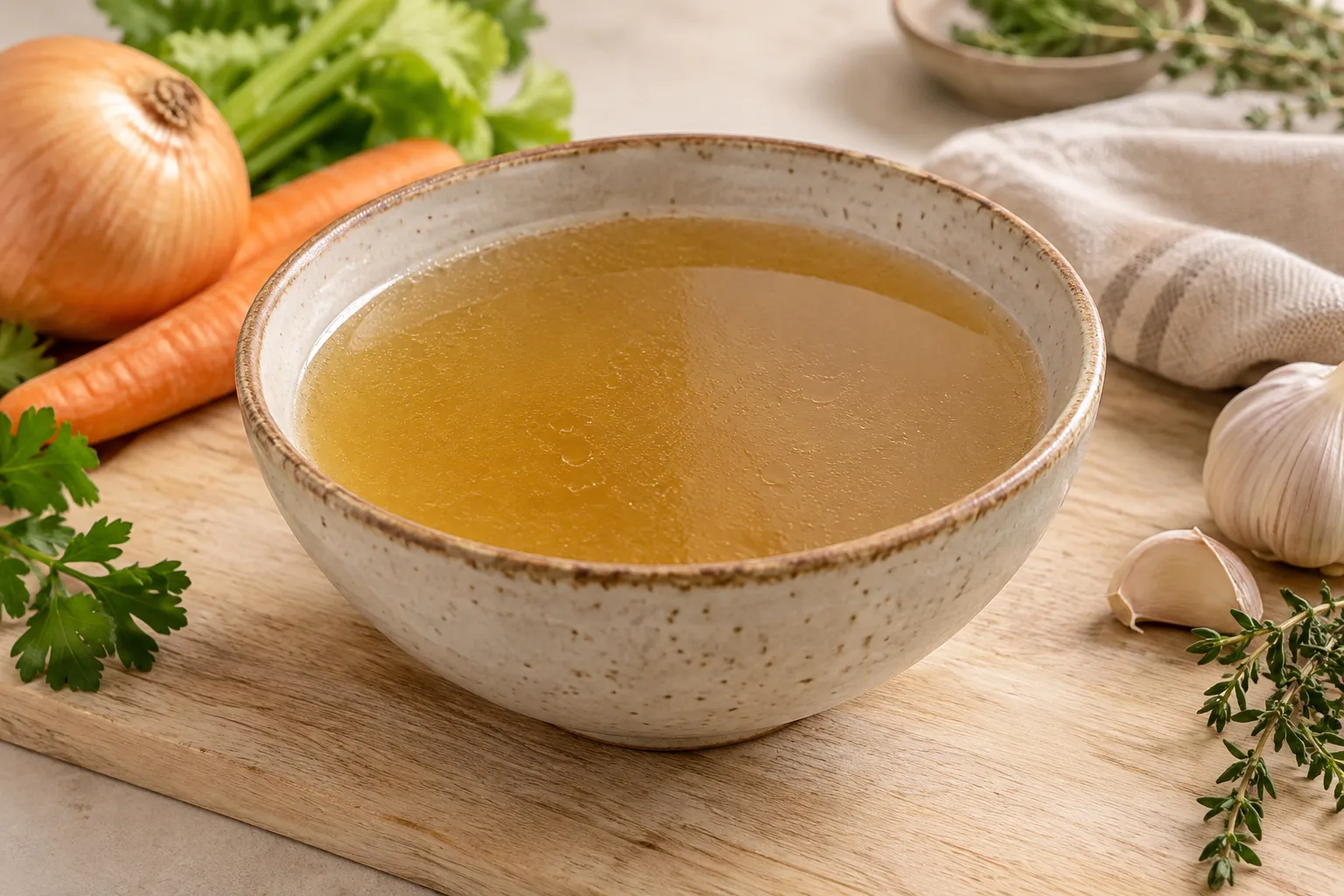
Broth is a culinary liquid made by cooking one or more ingredients, such as meat, fish or vegetables, in water. Herbs and other aromatic ingredients may also be used, and the resulting liquid can be served on its own or added to another dish. Broths come in different varieties, so the word does not indicate one fixed recipe or flavor. Some are lighter, while others are more concentrated; concentrated liquids may also be described as stocks. Broth is not necessarily a finished soup: it can be the base to which other ingredients are added. This profile uses “broth” for the broad category of cooking liquids, not for a specific recipe or a product with a standard ingredient list.
When to use it
Use broth when you want to add a flavorful liquid to a dish or cook ingredients in something other than plain water. It can form the base of a soup or cream soup, go into stews and braises, or be used while cooking rice and other grains. Broth can also be used in sauces. Choose a variety that fits the dish: vegetable broth for a vegetable-led preparation, or meat, poultry or fish broth when those flavors make sense. If the broth is concentrated, remember that its intensity may overwhelm delicate ingredients; add it gradually and taste as you go.
How to use it
If you are using packaged broth, read its label: the product name, ingredients, storage directions and use instructions can vary. Add it as the liquid in a soup, cream soup, stew, sauce or rice dish, following the recipe. Use it to cook grains or pasta only when its flavor suits the other ingredients. For homemade broth, ingredients are cooked in water and may be flavored with vegetables, herbs or spices; foam that rises during cooking is commonly skimmed off. A broth can be reduced to make a more concentrated liquid, but this also intensifies its flavor. Taste the dish before making adjustments, since broths and packaged products do not necessarily have the same ingredients or concentration.
Flavour and texture
Flavor depends on the ingredients and on how concentrated the liquid is: vegetable broth differs from meat or fish broth. Broth can be light or more concentrated and intense; there is no single flavor or texture that describes every variety.
How to choose it
Check which kind of broth you are buying and read the ingredient list, because the word “broth” does not guarantee a particular composition. Choose a variety that suits the recipe and consult the package for storage and use directions. If you need to avoid an ingredient or allergen, verify the specific product label.
Storage
Storage instructions depend on the product and its packaging. For packaged broth, follow the label’s storage and use directions, especially after opening. For homemade broth, handle it with care and avoid leaving it unattended; this profile does not assign a universal storage period to every recipe.
Substitutions
You can replace one kind of broth with another—for example, vegetable broth instead of meat or fish broth—if its flavor fits the other ingredients. Another meat, poultry or fish broth may also work, depending on the recipe. Each variety has its own flavor and concentration, so the finished dish may change; taste and adjust it.
Common mistakes
Do not assume that all broths have the same ingredients, flavor or concentration. A variety that does not suit the dish can change its character, and concentrated broth can overpower delicate flavors. Broth is not automatically the same as finished soup or concentrated stock; check the package ingredients and directions too.
Safety and allergens
For packaged products, check the ingredients and follow the label’s storage and use directions. If allergen or storage information matters to you, verify the specific product rather than assuming all broths are alike.
Culinary uses
- base líquida para sopas y cremas
- líquido de cocción para guisos, arroces y salsas
Recommended techniques
- cocer a fuego suave para extraer sabor
- desespumar durante la cocción
- reducir para concentrar el líquido
Pairs well with
- verduras y hierbas aromáticas
- carne, pescado o marisco, según el tipo de caldo
- arroz, pasta y otros cereales
Frequently asked questions
Is broth the same as soup?
Not necessarily. Broth is a liquid that can be served on its own or used as a base; soup may contain broth along with other ingredients.
What kinds of broth are there?
Common varieties include vegetable, meat, poultry and fish broth. The exact ingredients depend on the preparation or product.
Can I substitute one broth for another?
Yes, when the flavor works with the dish. Vegetable broth can replace meat or fish broth in some recipes, but the finished flavor will change.
Estimated nutrition
- Fat
- 0.07 g
- Saturates
- 0.03 g
- Carbohydrate
- 1.02 g
- Sugars
- 0.57 g
- Fibre
- 0 g
- Protein
- 0.23 g
- Salt
- 0.76 g
Sources and review
Automatically researched, cross-checked and validated content. Sources consulted:
- TIEMPO-TEMPERATURA.pdf aesan.gob.es
- En el etiquetado alimentario hay algunas menciones que son obligatorias eletiquetadocuentamucho.aesan.gob.es
- aprovechamiento COOKING BATCH cocina de y Silvia antón | maite lópez unav.edu
- Client Challenge doi.org
- Cooking Food Storage | USU extension.usu.edu
- The Essential Glossary of Cooking Terms for the Culinary Arts - Escoffier escoffier.edu
- Caldo - Wikipedia, la enciclopedia libre es.wikipedia.org
- Caldo de pescado (fumet): definición, tipos y usos culinarios es.alegsaonline.com
- Caldo de Huesos: Beneficios, preparación y usos culinarios | Freshis.com freshis.com
- ▷ El caldo es el ingrediente principal de sopas, salsas, guisados y estofados【 Kitchen Academy 】 kitchenacademy.es
- Preparing an Emergency Food Supply, Long Term Food Storage | Food Preservation | Food | Extension | UGA FACS fcs.uga.edu
- i ^ i ^ii^^ Núm. 15-79 HD SUBPRODUCTOS DE LA INDUSTRIA CERVECERA EN LA mapa.gob.es
- Safety of Stored Foods | Home & Garden Information Center hgic.clemson.edu
- All Topics - CSU Extension extension.colostate.edu
- https://hgic.clemson.edu/ SAFETY OF STORED FOODS ucanr.edu
- Diferencias entre caldo y fondo bonviveur.es
- WIN79 : Link SLOT777 Terbaik Hari Ini Situs Slot Gacor Maxwin Gampang Jackpot Hoki wasabidelnorte.es