- Category
- Herbs and spices
- State
- Dry
- Usual unit
- teaspoon
What it is
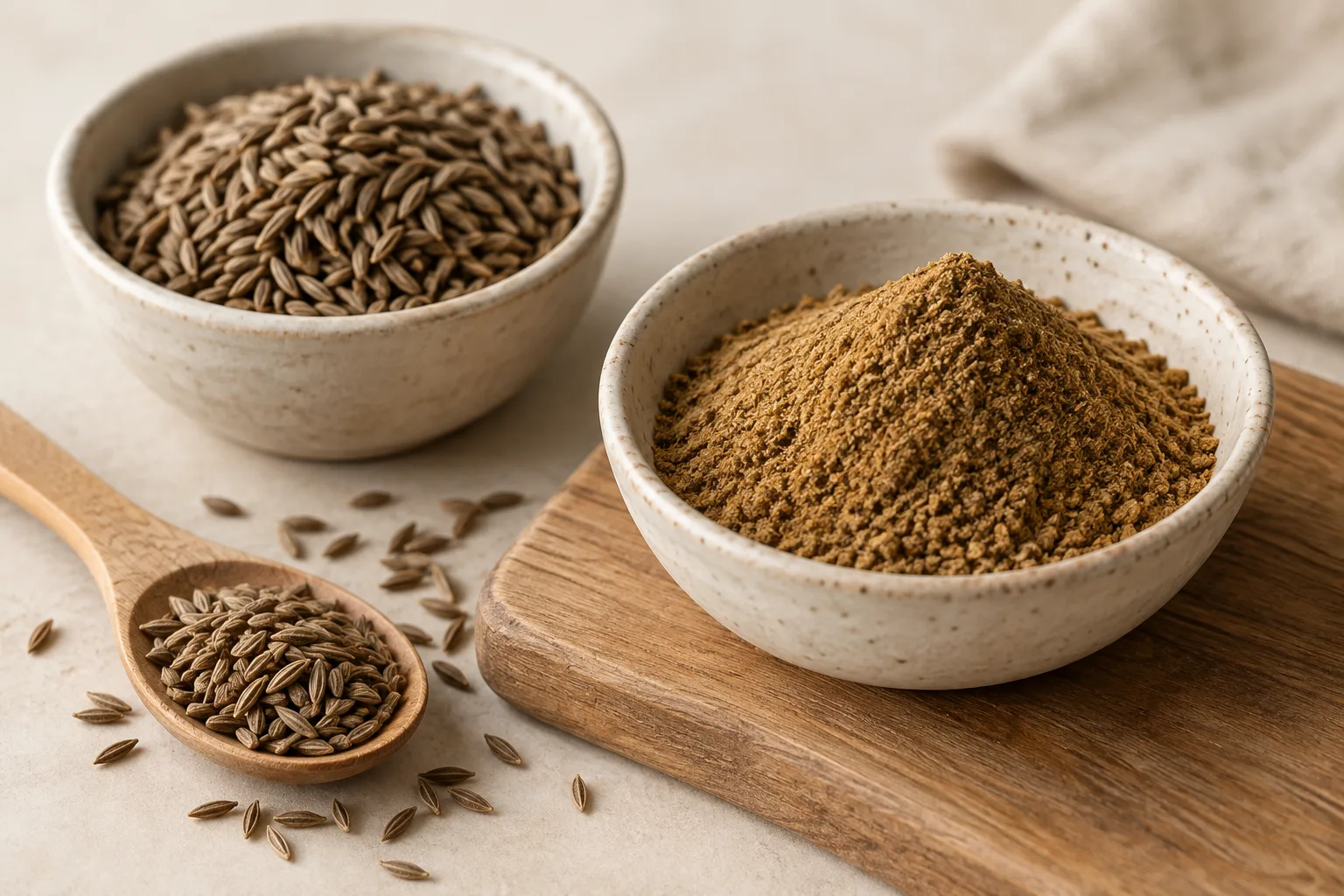
Cumin, Cuminum cyminum, is an aromatic spice in the Apiaceae family. Its dried seeds are used in cooking, either whole or ground; although commonly called seeds, the culinary ingredient is sold as a dried spice. Its flavor is warm and penetrating, with slightly bitter and somewhat sweet notes described in the available sources. Cumin is used in a range of cuisines and appears in dishes such as hummus, couscous, curry, stews and chili con carne. Do not automatically treat it as the same ingredient as black cumin: that name can refer to Nigella sativa, a different species from common cumin.
When to use it
Use cumin when you want a dish to have a warm, recognizable aroma, especially in preparations with legumes, vegetables, rice, couscous, sauces or stews. It is used in spice mixtures and in dishes such as hummus, curry and chili con carne. Because its flavor can stand out readily, add it moderately and adjust to taste as you cook. Whole seeds and ground cumin are different forms of the same ingredient, but they are not added in quite the same way and do not provide the same texture.
How to use it
Cumin can be used whole or ground. To bring out the aroma of the seeds, one source recommends dry-toasting them and then grinding them with a mortar or grinder; do not let the toasting distract from the dish’s main flavor, and follow a recipe if it gives specific directions. You can also add whole seeds to the oil used as the base for stews or braises. Ground cumin mixes readily into curries, sauces, hummus, vegetables and other preparations. Start with a small amount, taste and adjust: the culinary sources consulted caution that too much can mask the flavors of other ingredients.
Flavour and texture
Cumin has a warm, penetrating and distinctive aroma. The available descriptions characterize its flavor as somewhat bitter, slightly pungent and also a little sweet, with a citrus note mentioned for common cumin. Whole seeds are visible and give a different texture from the powder; ground cumin blends and disperses more readily through a dish. Dry-toasting followed by grinding is recommended to intensify and refresh the aroma, not to change the ingredient itself.
How to choose it
Choose the form that suits the recipe: whole seeds for flavoring oil or for toasting and grinding, and ground cumin for mixing directly into dishes and spice blends. The sources describe both forms as common culinary options. Check the product name, because “black cumin” can refer to Nigella sativa, a species different from common cumin. The available evidence does not establish objective standards for freshness, visual quality, preferred origin or harvest date; consult the product label for such details.
Storage
The available evidence describes culinary cumin as dried seeds and also as a ground spice, but it does not specify ideal storage conditions or a storage life. Check and follow the package directions, especially after opening. Keep the product clearly identified so common cumin is not confused with products labeled black cumin, which may refer to a different species. A specific storage period or more detailed storage condition cannot be recommended here without support from the available sources.
Substitutions
Whole and ground cumin are two forms of the same ingredient and can replace one another in some recipes, but they differ in texture and in how they disperse through a dish. If replacing seeds with powder, add it so it distributes evenly; if replacing powder with seeds, remember that the seeds will be noticeable when eaten and may need to be toasted or ground depending on the recipe. Black cumin is not automatically an equivalent substitute: the name can refer to a different species.
Common mistakes
The easiest mistake is adding so much cumin that its aroma overwhelms other flavors; start with a little and taste. Also distinguish whole seeds from the ground product, since they blend differently and create a different texture. Do not assume black cumin is simply another form of common cumin: it can be a different species. If a recipe calls for toasting the seeds, watch them and follow its directions rather than assuming an unsupported time or temperature.
Safety and allergens
Use cumin as a culinary spice and follow the package directions. The available sources do not provide a specific official warning for ordinary food use or particular safety instructions. If you have a known sensitivity to this ingredient, avoid eating it and seek advice from a health professional if a reaction occurs.
Culinary uses
- Aportar aroma y sabor a platos salados
- Condimentar mezclas, guisos y preparaciones de legumbres
Recommended techniques
- Tostar brevemente las semillas en seco y molerlas después
- Añadir semillas enteras al aceite para aromatizar la base de un guiso
Pairs well with
- Hummus y otras preparaciones de garbanzos
- Cuscús, curry, verduras y guisos
Frequently asked questions
Is cumin sold whole or ground?
Both forms are used in cooking. Whole seeds can be toasted and ground or used to flavor oil; ground cumin can be mixed directly into dishes.
Is cumin the same as black cumin?
Not necessarily. Common cumin is Cuminum cyminum; black cumin can refer to Nigella sativa, a different species.
Which dishes work well with cumin?
The sources mention hummus, couscous, curries, stews, vegetables and chili con carne as preparations that use cumin.
Estimated nutrition
- Fat
- 0 g
- Saturates
- 0 g
- Carbohydrate
- 0 g
- Sugars
- 0 g
- Fibre
- 31.2 g
- Protein
- 0 g
- Salt
- 0 g
Sources and review
Automatically researched, cross-checked and validated content. Sources consulted:
- Client Challenge doi.org
- The Essential Glossary of Cooking Terms for the Culinary Arts - Escoffier escoffier.edu
- Cómino: qué es y para que sirve | JUST SPICES ® justspices.es
- ALIMENTARIA aesan.gob.es
- Selling or Serving Food at Events | El Camino College | Torrance, CA elcamino.edu
- Celebrating the Food of Oaxaca with Chef Ivy Stark | Institute of Culinary Education ice.edu
- Le Cordon Bleu Online Learning List of Courses cordonbleu.edu
- Food and Nutrition Services | Atrium Health Wake Forest Baptist wakehealth.edu
- A Taste of Japan—Alum blogs about Japanese food | St. John's College sjc.edu
- AT THE MARKET (PART I) cesr.usc.edu
- Propiedades y beneficios del Comino - Trevijano trevijano.com
- Comino: qué es, propiedades, beneficios y uso en la cocina bonviveur.com
- Comino - Región de Murcia Digital regmurcia.com
- Comino: mucho más que una especia para dar sabor a tus platos - Ability Salud abilitysalud.es