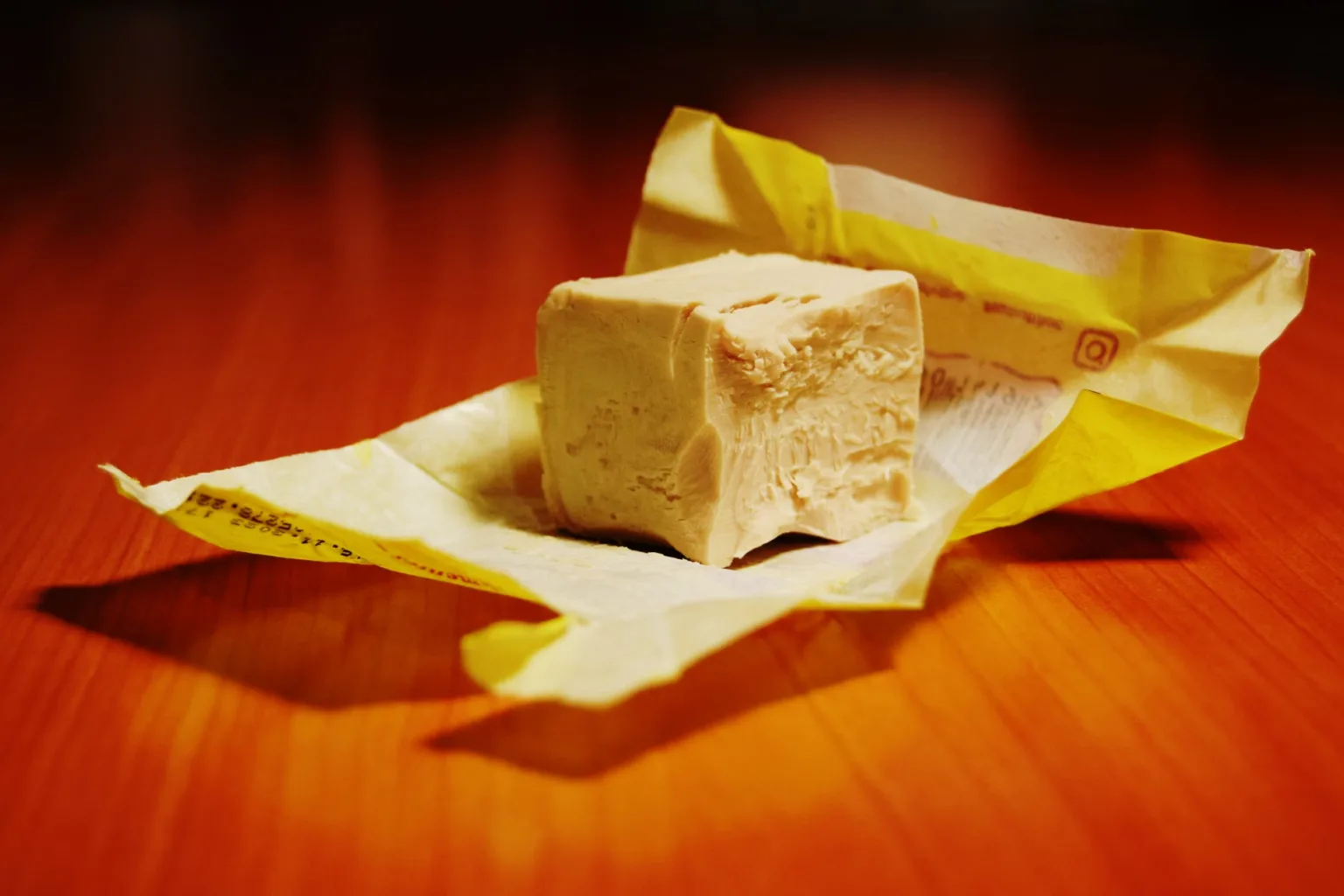
- Category
- Baking
- State
- Fresh
- Usual unit
- g
What it is
Fresh baker’s yeast is living yeast sold in a moist, pressed form, often as a block. Yeast is a unicellular fungus that ferments sugars and produces carbon dioxide; this gas helps fermented dough expand. In cooking, fresh baker’s yeast is used mainly for bread and pizza dough, as well as some enriched or sweet doughs. It is not the same as chemical baking powder, which raises a mixture through gas formation from a chemical reaction rather than fermentation. It is also different from dry baker’s yeast: the products have different forms and are not necessarily used in equal amounts.
When to use it
Choose fresh baker’s yeast when a recipe specifically calls for fresh or compressed yeast, or when making fermented bread, pizza, or another bakery dough. It suits doughs that need time to ferment and rise, with the aromas and flavor associated with that process. The dough must rest after the yeast is incorporated so fermentation can take place; fresh yeast does not act like a chemical leavener that produces gas as a mixture cooks. If you have only dry yeast, check the recipe or product directions for a conversion because the two forms are not measured in the same amount by default.
How to use it
First confirm that the recipe calls for fresh baker’s yeast, then measure the stated amount. Crumble it or dissolve it in some of the recipe’s water before adding it to the other ingredients; a Le Cordon Bleu recipe, for example, dissolves fresh yeast in water before mixing it with flour and the other components. Incorporate the yeast into the dough and let the dough rest as directed so fermentation can help leaven it. The dough’s behavior also depends on its other ingredients, including flour, salt, sugar, and fats. Do not replace fresh yeast with an equal weight of dry yeast without checking a conversion: one guide gives three parts fresh yeast to one part dry yeast by weight as a reference, but the recipe or product instructions should guide the choice.
Flavour and texture
Fresh yeast can contribute flavor nuances, while fermentation produces gas and helps develop the dough. Before use, fresh baker’s yeast has a moist, pressed texture, unlike the dehydrated form of dry yeast. The flavor and texture of a baked product also depend on fermentation and the other ingredients, so they should not be attributed to the yeast alone.
How to choose it
Look for a product clearly identified as fresh, compressed, or baker’s yeast, and distinguish it from chemical baking powder and dry yeast. Fresh yeast is sold as a moist mass or pressed block; dry yeast is dehydrated and calls for different quantities. Read the product label and follow the maker’s directions, choosing the form that matches your recipe. The available evidence does not establish additional freshness tests or a universal commercial shelf life.
Storage
The consulted guide says to keep fresh yeast refrigerated. Also follow the storage directions on the package, since the available evidence does not give a universal storage period or a specific temperature. Do not apply storage information for dry yeast to fresh yeast: they are different product forms. Use the package directions to decide how to store the product and for how long.
Substitutions
Dry baker’s yeast can replace fresh yeast if you adjust the amount using an appropriate conversion; one guide gives three parts fresh yeast to one part dry yeast by weight as a reference. Check the recipe or package directions. Sourdough starter can also leaven dough, but it involves a different culture and process, so it is not a direct, equal-quantity swap. Chemical baking powder works through gasification and does not reproduce baker’s yeast fermentation.
Common mistakes
Do not confuse baker’s yeast with chemical baking powder: one ferments dough and the other creates gas through a chemical reaction. Do not swap fresh and dry yeast in equal amounts; one guide gives a three-to-one weight reference. Another common mistake is skipping the dough rest, which gives fresh yeast time to act in a fermented dough.
Safety and allergens
Use clean utensils and follow the package’s storage and use directions. The available evidence does not identify a specific safety warning for fresh baker’s yeast.
Culinary uses
- Biological leavening for dough
- Fermentation that develops dough aromas and flavor
Recommended techniques
- Dissolve or disperse in water before mixing into dough
- Mix into dough and allow it to rest so fermentation can leaven it
Pairs well with
- Flour and water in bread dough
- Flour, water, salt, and dough ingredients such as sugar or fats
Frequently asked questions
Is fresh yeast the same as baking powder?
No. Fresh yeast ferments dough; baking powder raises mixtures through gas formation from a chemical reaction.
Can I replace fresh yeast with dry yeast?
Yes, if you adjust the amount according to the recipe or package. One guide gives three grams of fresh yeast for each gram of dry yeast as a reference.
How should I store fresh yeast?
The consulted guide says to refrigerate it. Follow the package directions too, as no universal storage period is established here.
Estimated nutrition
- Fat
- 1.9 g
- Saturates
- 0.24 g
- Carbohydrate
- 18.1 g
- Sugars
- 0 g
- Fibre
- 8.1 g
- Protein
- 8.4 g
- Salt
- 0.08 g
Sources and review
Automatically researched, cross-checked and validated content. Sources consulted:
- REGLAMENTO (UE) No 1169/2011 DEL PARLAMENTO ... eletiquetadocuentamucho.aesan.gob.es
- Tipos de levadura, características y usos | IFEMA MADRID ifema.es
- Levadura: qué es, tipos y beneficios bonviveur.com
- The Essential Glossary of Cooking Terms for the Culinary Arts - Escoffier escoffier.edu
- Agencia Española de Seguridad Alimentaria y Nutrición aesan.gob.es
- Food as expression of social identity and intergroup relations in ... scholar.uc.edu
- Empleo de tubérculos andinos como sustituto de la levadura fresca para la elaboración de productos de panadería en el Cantón Rumiñahui doi.org
- Quédate en casa y cocina: #LeCordonBleuAtHome (Pan fino de tomate) cordonbleu.edu
- This document is discoverable and free to researchers ... ageconsearch.umn.edu
- Selenium | Linus Pauling Institute | Oregon State University lpi.oregonstate.edu
- UTSA-Special-Collections-Recetas-Cookbook-2020.pdf lib.utsa.edu
- impact of potassium chloride on saltiness, bitterness ... - K-REx krex.k-state.edu
- Kimchi casero: guía científica para una fermentación segura | CAES Field Report fieldreport.caes.uga.edu
- Distintos usos de la levadura: Conócelos aquí levanova.es
- Levadura de panadería: usos y aplicaciones | AB Mauri abmauri.es