- Category
- Fish and seafood
- State
- Fresh
- Usual unit
- g
What it is
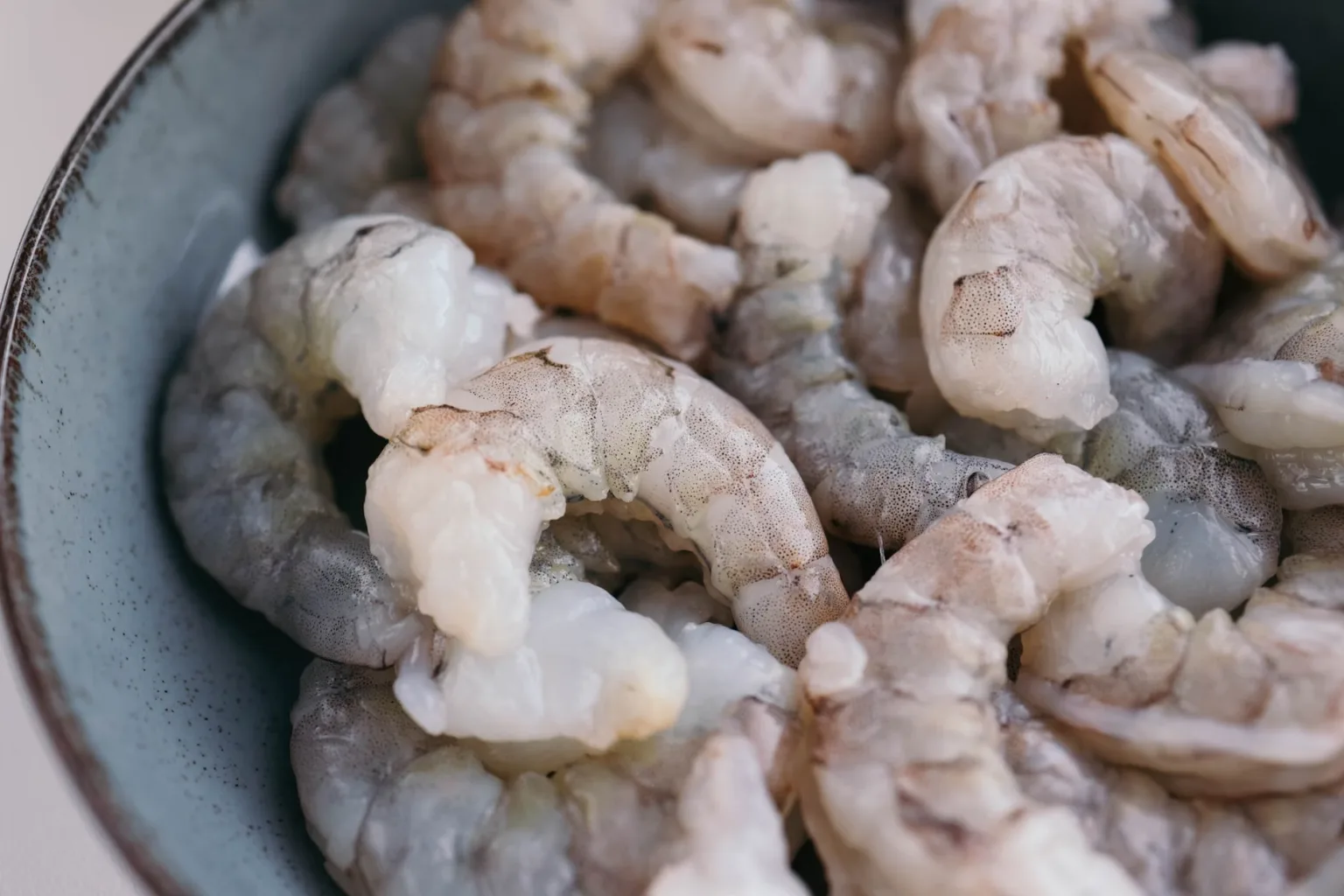
A prawn is a marine crustacean with ten legs and a semi-hard shell. It resembles a shrimp but is not exactly the same product. Prawns are available fresh or frozen, raw or cooked, so check the form before choosing one and adapt the preparation accordingly. Raw prawns described by the source are dark grey and turn pink when cooked; a fresh specimen should have a shiny, firm shell. The flesh can be served on its own or added to hot and cold dishes.
When to use it
Choose prawns when you want seafood to serve as a main dish or appetizer, or to add to rice, pasta, legume dishes, omelettes, and salads. Fresh prawns can be used in cooked preparations; cooked frozen prawns are convenient for cold dishes once thawed in the refrigerator. Check whether a recipe calls for raw or cooked prawns, and whether you need to peel them and remove the dark vein along the back, which can taste bitter.
How to use it
First decide whether to serve the prawns whole or peeled. If adding peeled prawns to a recipe, the source recommends removing the dark vein along the back because it can taste bitter and affect the dish. Prawns can be boiled, grilled with lemon, fried or sautéed with garlic, and added to rice, pasta, legumes, omelettes, or scrambled eggs. They also work in salads, seafood salad, and other cold appetizers. If using cooked frozen prawns in a cold dish, thaw them slowly in the refrigerator and follow the package directions; do not refreeze them after thawing.
Flavour and texture
The source describes prawns as having an appealing flavor and notes that their flesh can remain firm and springy after suitable cooking. Their appearance depends on their form: raw specimens are dark grey and turn pink when cooked. Fresh prawns should have a shiny, firm shell. Removing the dark vein from peeled prawns helps prevent it from adding bitterness to a dish.
How to choose it
When buying fresh prawns, look for a shiny, firm shell. Reject specimens that feel soft or have a slight ammonia-like smell, signs the source associates with lack of freshness. Also check whether you are buying them raw, cooked, fresh, or frozen, since these forms call for different uses. For packaged products, check the product name, allergen information, and storage directions on the label.
Storage
The source describes fresh prawns and several frozen forms, including cooked frozen prawns. For the latter, it advises thawing them slowly in the refrigerator before eating and not refreezing them once thawed. It does not give a specific storage duration or one method that applies to every product: follow the label and the seller’s directions for the prawns you bought.
Substitutions
Where a recipe allows a change in form, frozen prawns can stand in for fresh ones; thaw them according to the package directions and check whether they are raw or cooked. In salads, appetizers, and other cold dishes, cooked frozen prawns can replace raw prawns that the recipe would otherwise cook, provided the preparation can use seafood that is already cooked.
Common mistakes
Do not choose fresh specimens with soft shells or a slight ammonia-like smell. Do not overlook whether the product is raw or cooked, since that changes how it should be added to a recipe. If peeling the prawns, remember that the dark vein along the back can taste bitter. Do not refreeze prawns after thawing, and do not guess at a storage period in place of the product’s instructions.
Safety and allergens
Check the label and follow its storage and use directions. When buying unpackaged prawns or eating them in a food-service setting, ask where to find allergen information; food information should identify allergy- or intolerance-causing substances as applicable. Avoid fresh prawns showing the signs of deterioration described, and do not refreeze prawns that have already thawed.
Culinary uses
- Plato principal
- Ingrediente para arroces, pastas, legumbres y ensaladas
Recommended techniques
- Cocción en agua
- A la plancha
- Salteado o frito
- Incorporación a arroces y tortillas
Pairs well with
- Ajo
- Limón
- Arroz
- Pasta
- Legumbres
Frequently asked questions
How can I recognize fresh prawns?
Look for a shiny, firm shell. Reject specimens that feel soft or have a slight ammonia-like smell.
How should cooked frozen prawns be thawed?
The source advises thawing them slowly in the refrigerator before eating. Follow the package directions as well.
Can prawns be refrozen after thawing?
The source consulted says not to refreeze them once they have thawed.
What dishes can I make with prawns?
Use them in salads, appetizers, seafood salad, rice, pasta, legumes, omelettes, or scrambled eggs, or serve them grilled.
Estimated nutrition
- Fat
- 3.95 g
- Saturates
- 0.66 g
- Carbohydrate
- 26.3 g
- Sugars
- 7.02 g
- Fibre
- 1.8 g
- Protein
- 5.26 g
- Salt
- 1.45 g
Sources and review
Automatically researched, cross-checked and validated content. Sources consulted:
- En el etiquetado alimentario hay algunas menciones que son obligatorias eletiquetadocuentamucho.aesan.gob.es
- Client Challenge doi.org
- The Essential Glossary of Cooking Terms for the Culinary Arts - Escoffier escoffier.edu
- Gastronomy and Geography of Southern Spain aquila.usm.edu
- Agencia Española de Seguridad Alimentaria y Nutrición aesan.gob.es
- Spanish Surf & Turf | Institute of Culinary Education ice.edu
- quantitative-assessment-of-relative-risk-to-public-health- ... seafood.oregonstate.edu
- Sensory and Physical Assessment of Microbiologically Safe ... vtechworks.lib.vt.edu
- Is That Lobster or Hermit Crab? What You’re Really Eating - Knowledge at Wharton knowledge.wharton.upenn.edu
- Culinary Arts - Hennepin Technical College hennepintech.edu
- Economic Contributions of U.S. Seafood Imports - Food and Resource Economics Department - University of Florida, Institute of Food and Agricultural Sciences - UF/IFAS fred.ifas.ufl.edu
- Ingredientes utilizados para producir pescado y langostinos de cultivo - Skretting skretting.com
- Mayo: los langostinos | Consumer consumer.es