- Category
- Vegetables
- State
- Fresh
- Usual unit
- unit
What it is
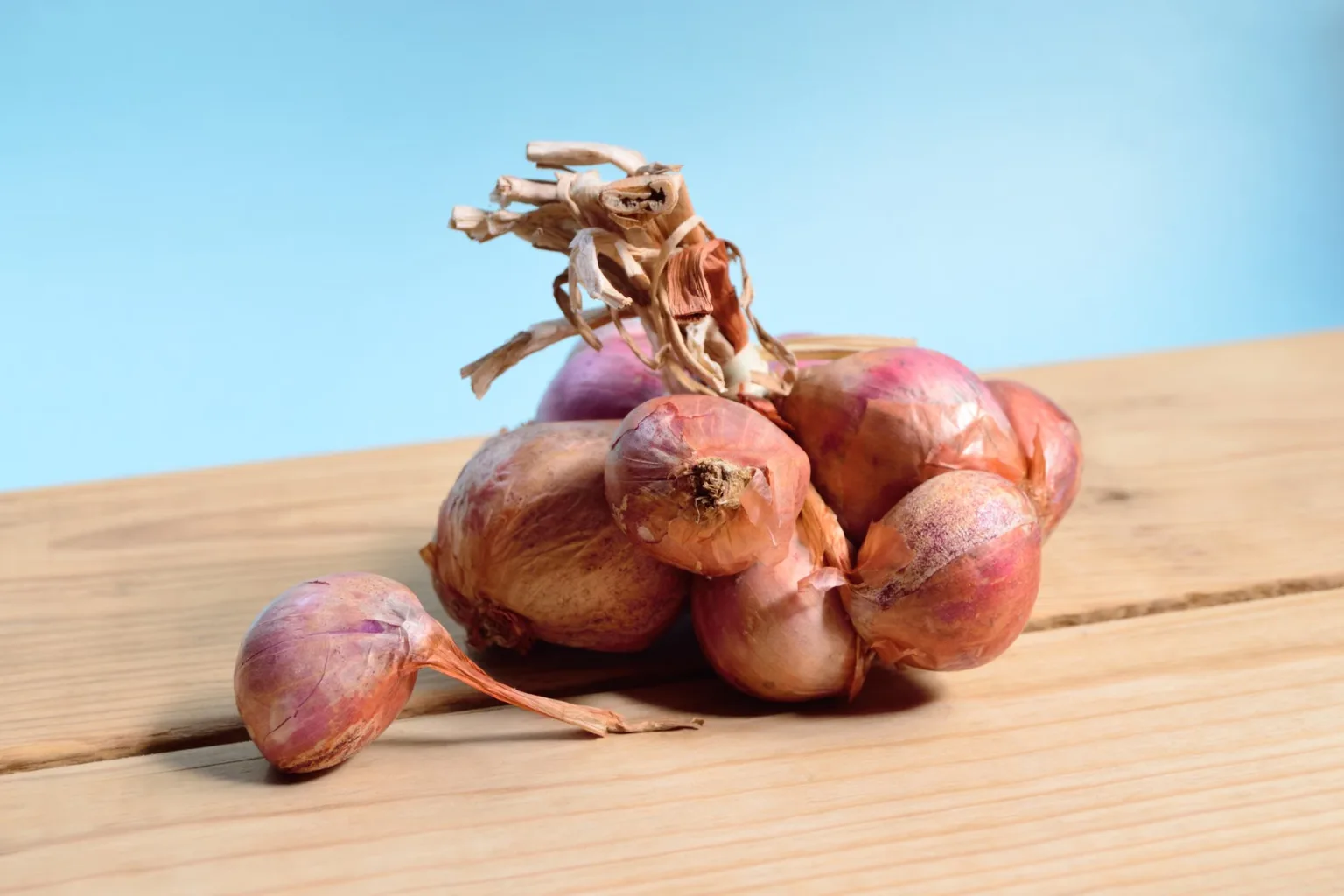
A shallot is an edible bulb in the allium family, alongside onions, garlic and leeks. It is usually smaller than an onion and may be elongated or round; the varieties described in the supplied sources range from white and gray to copper, pink and red. Its aroma and flavor recall both onion and garlic, but are often described as more delicate. Some sources describe shallots as growing in clusters, while also noting variation in shape, size and color across varieties.
When to use it
Choose shallots when you want an onion-and-garlic-family aroma without raw onion overwhelming a salad or vinaigrette. Cooked, they can form the aromatic base of sauces, soups and stews, or serve as an accompaniment to meat, fish and cheese-based appetizers. Their delicate flavor is also useful when you want a fragrant note in a dish without making the bulb its dominant flavor.
How to use it
Trim the ends and remove the dry outer skin before chopping. One source suggests halving a shallot lengthwise to make peeling easier, then removing the outer layer. Finely chop it for salads or vinaigrettes, or add it to sauces, soups and stews. You can also cook it until browned, caramelize or confit it, or roast it whole or halved. The sources describe both raw and cooked uses but do not establish a universal cooking time; judge doneness according to the recipe and the size of the pieces.
Flavour and texture
Shallots are aromatic, mild and gently sweet, with a little sharpness when raw and notes reminiscent of onion and garlic. Compared with common onion, they are often described as more delicate, allowing them to contribute aroma without dominating a dish as readily. Sources describe the bulb as small, with a fine, tender texture; its precise flavor can vary by variety and by whether it is served raw or cooked.
How to choose it
Look for firm shallots with clean, dry, glossy-looking skins. One culinary source recommends smaller bulbs for stronger flavor, while other sources describe varieties in different sizes, shapes and colors. Size and color therefore do not identify every variety; prioritize firm bulbs without visible deterioration and with intact, dry skins.
Storage
One culinary source says whole shallots can keep at room temperature for weeks before they begin to sprout. Once peeled, it recommends refrigerating them, preferably in an airtight container. The supplied sources do not establish official conditions or an exact storage life for every shallot, so check the bulbs and follow any product-specific storage directions available.
Substitutions
Onion is the closest substitution described in the sources; one suggests using about one-half to one-third of the amount of shallot called for. The flavor will differ and may be stronger. Garlic is also in the allium family and can contribute a related flavor note, but the sources do not provide a quantity equivalence for replacing shallots with garlic.
Common mistakes
Do not automatically replace shallots with an equal quantity of onion: one source recommends using less to better approximate their milder profile. Do not assume all shallots are elongated, reddish or the same size; sources describe variation in shape and color. And do not mistake a delicate flavor for a lack of aroma: shallots can make a noticeable contribution whether used raw or cooked.
Safety and allergens
The supplied sources contain no official shallot-specific safety warning. As a general precaution, use sound bulbs and follow ordinary food-hygiene practices for fresh produce.
Culinary uses
- Aromatic base for sauces, soups and stews
- Fresh or cooked allium accent for salads and dressings
- Vegetable accompaniment for meat, fish and cheese dishes
Recommended techniques
- Finely chop or mince for raw dressings and salads
- Sauté or brown gently for cooked dishes
- Caramelize, confit or roast whole or halved
- Add to soups, stews and sauces
Pairs well with
- Meat and poultry
- Fish
- Cheese and foie
- Salads and vinaigrettes
- Soups and sauces
Frequently asked questions
Can shallots be eaten raw?
Yes. Sources describe using them in salads and vinaigrettes; raw shallots have a slight sharpness and are often milder than common onion.
What do shallots taste like?
They are aromatic, mild and gently sweet, with a little sharpness when raw and flavor notes reminiscent of onion and garlic.
How can I substitute for shallots?
Use a smaller amount of onion; one source suggests roughly one-half to one-third of the stated shallot amount. The flavor will not be identical.
Estimated nutrition
- Fat
- 0 g
- Saturates
- 0 g
- Carbohydrate
- 13.3 g
- Sugars
- 6.67 g
- Fibre
- 16.7 g
- Protein
- 0 g
- Salt
- 0.05 g
Sources and review
Automatically researched, cross-checked and validated content. Sources consulted:
- Client Challenge doi.org
- The Essential Glossary of Cooking Terms for the Culinary Arts - Escoffier escoffier.edu
- ¿Qué es la chalota? | Quirónsalud quironsalud.com
- Chalotas | www.cocinista.es cocinista.es
- Chalota: qué es, propiedades y usos en la cocina del sustituto de la cebolla bonviveur.com
- USDA FoodData Central libguides.marist.edu
- Using and Preserving Chayote - National Center for Home Food Preservation nchfp.uga.edu
- shallots - Extension St. Croix County stcroix.extension.wisc.edu
- Professional Culinary Arts Level 3: "The Hungry Games" | Institute of Culinary Education ice.edu
- Vegetable Storage in Root Cellars | Cooperative Extension Service uaf.edu
- Faculty lighthouse.apps.austincc.edu
- Chalotas o escalonias | Gastronomía & Cía gastronomiaycia.com
- Cebolla chalota: un tesoro en la cocina y el huerto - Abonos Calsilla abonoscalsilla.com