- Category
- Grains, flour and pasta
- State
- Powdered
- Usual unit
- g
What it is
Strong bread flour is wheat flour whose protein content and quality help form gluten when hydrated. This network makes dough elastic and helps trap carbon dioxide produced during fermentation, contributing to structure and volume. In professional terms, flour strength may be expressed as a W value: a higher value indicates greater strength. Labels and the characteristics of individual products vary, so the name alone cannot predict exactly how a flour will behave. It is a dry, finely milled ingredient intended to be combined with liquids and other ingredients.
When to use it
Choose strong flour when a recipe calls for dough that must be kneaded, stretched or hold its shape through fermentation, especially bread and enriched doughs containing fat and sugar. Depending on the recipe and the particular flour, it can suit brioche, pizza, focaccia or similar bakes. A simple loaf does not always require it, while a lower-strength flour may be more suitable for cakes or biscuits. Follow the recipe and check the label: flour strength and protein quality can differ between products.
How to use it
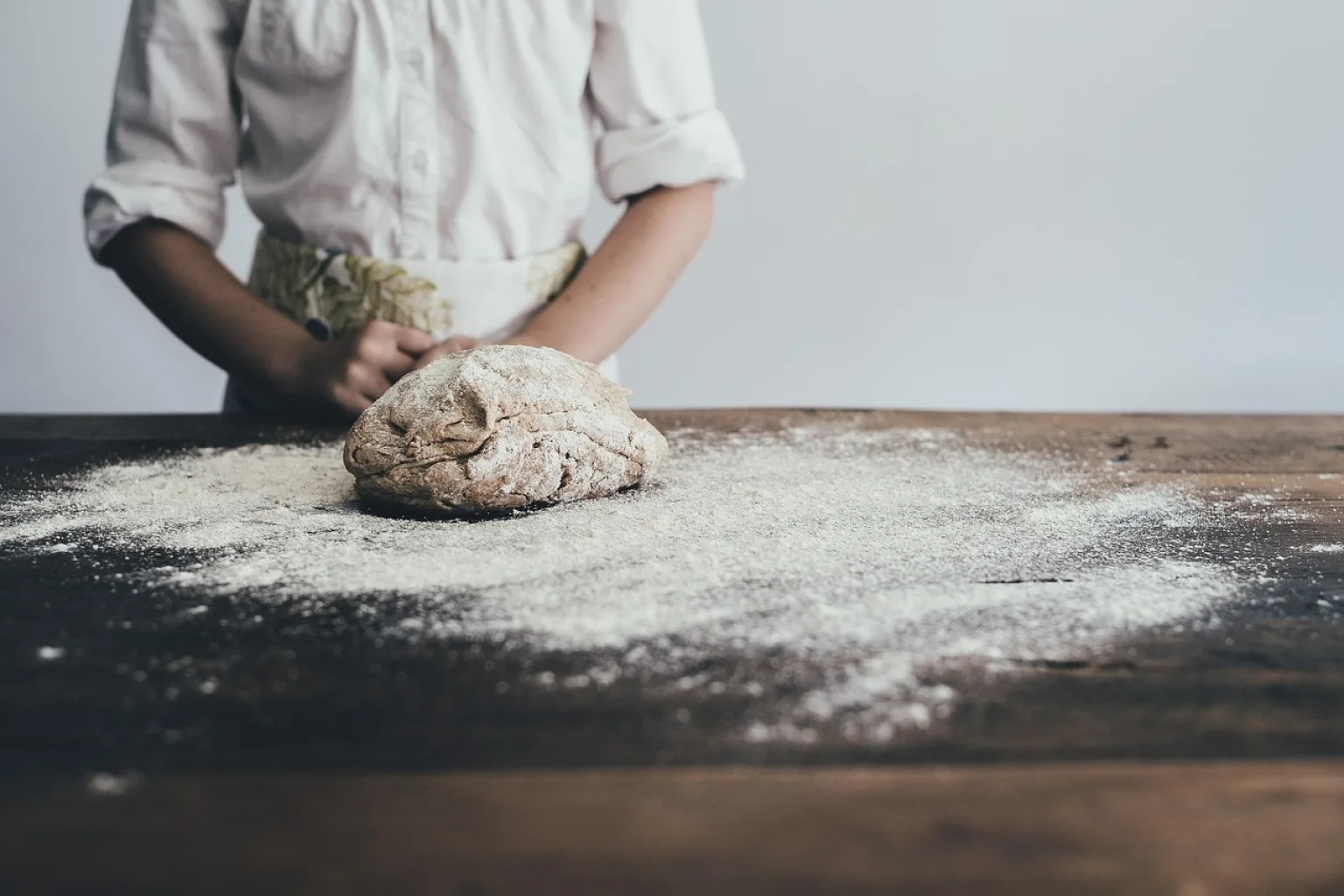
Weigh the flour and combine it with the liquids and other ingredients specified in the recipe; do not assume every strong flour absorbs exactly the same amount. Mix until no dry patches remain, then knead as the method directs to develop a cohesive, elastic dough. For yeasted dough, ferment according to the recipe. Strong flour can help retain gas, but it does not replace proper mixing, kneading or fermentation. Strong flour is used in bread and enriched-dough recipes: one tomato flatbread recipe, for example, combines it with water, yeast, salt and other ingredients, then mixes and kneads the dough. Adjust to the recipe and the flour rather than relying on a universal rule.
Flavour and texture
Its flavour is generally quite neutral, particularly when refined. Its practical characteristic is the way the dough behaves: once hydrated, it can become elastic and form a structure that holds gas. The finished texture also depends on the recipe, kneading and fermentation; the flour alone cannot guarantee a particular crumb.
How to choose it
Check the package for strength, a W value or recommended uses. A higher W value indicates greater strength, but protein quality also affects dough behaviour. Do not treat “strong” as a promise that the flour suits every bake; choose according to the recipe and compare product directions.
Storage
Keep it dry, in a tightly closed container and protected from moisture, following the manufacturer’s instructions. The available evidence does not establish a specific shelf life or temperature requirement for this product; check the package and avoid flour showing visible signs of deterioration.
Substitutions
Bread flour or all-purpose flour may work in some recipes, but the dough may be less elastic than with a stronger flour. Lower-strength flour may suit preparations such as some cakes, but it is not equivalent in a fermented or enriched dough. There is no universal substitution ratio: follow the recipe and assess the dough’s consistency.
Common mistakes
Common mistakes include using strong flour automatically for every recipe or assuming all products labelled “strong” are identical. Strength and absorption can vary. A more elastic dough is not necessarily a finished dough; kneading and fermentation still matter.
Safety and allergens
Contains wheat and gluten; do not serve it to people who need to avoid them. The supplied sources provide no product-specific official safety warning; handle it as a food ingredient and follow the package directions.
Culinary uses
- Estructurar masas panificadas mediante el gluten
- Aportar elasticidad y capacidad de retener gases de fermentación
Recommended techniques
- Amasar e hidratar para desarrollar la masa
- Fermentar masas de panadería y bollería
Pairs well with
- Levadura y agua
- Grasas y azúcares en masas enriquecidas
Frequently asked questions
What is strong bread flour used for?
It is mainly used for doughs that benefit from elasticity and structure, such as bread and some enriched doughs that are kneaded and fermented.
Can I use it for cakes?
A lower-strength flour is often more suitable for soft bakes such as some cakes. Follow the flour specified in your recipe.
Are all strong flours the same?
Not necessarily. W value, protein content and protein quality can vary, so check the label and recommended uses.
Estimated nutrition
- Fat
- 1.66 g
- Saturates
- 0.24 g
- Carbohydrate
- 72.5 g
- Sugars
- 0.31 g
- Fibre
- 2.4 g
- Protein
- 12 g
- Salt
- 0 g
Sources and review
Automatically researched, cross-checked and validated content. Sources consulted:
- Evaluación de harina de amaranto como ingrediente antioxidante para la preparación de matrices alimentarias funcionales doi.org
- Duke University Dissertation Template dukespace.lib.duke.edu
- Aplicaciones de la Biotecnología en Seguridad Alimentaria aesan.gob.es
- Food & Fun Afterschool hsph.harvard.edu
- Quédate en casa y cocina: #LeCordonBleuAtHome (Pan fino de tomate) cordonbleu.edu
- UTSA-Special-Collections-Recetas-Cookbook-2020.pdf lib.utsa.edu
- EL AMOR A TRAVÉS DE LA COCINA: EXPLORING THE scholarsbank.uoregon.edu
- A^r^icu^tur^a mapa.gob.es
- NUTRITION IN ME 4th GRADE Curriculum - Wsu s3.wp.wsu.edu
- Cómo mantenerse activo con diabetes y hacerlo de manera segura | CAES Field Report fieldreport.caes.uga.edu
- My Classroom Family-Vary Your Vegetables coloradosph.cuanschutz.edu
- Harina de fuerza: qué es y para qué utilizarla en cocina directoalpaladar.com
- Harina de Fuerza - Harinera El Molino harineraelmolino.com
- Diferencia entre harina de fuerza y harina floja o normal - Ybarra en tu cocina ybarraentucocina.com