- Category
- Vegetables
- State
- Fresh
- Usual unit
- unit
What it is
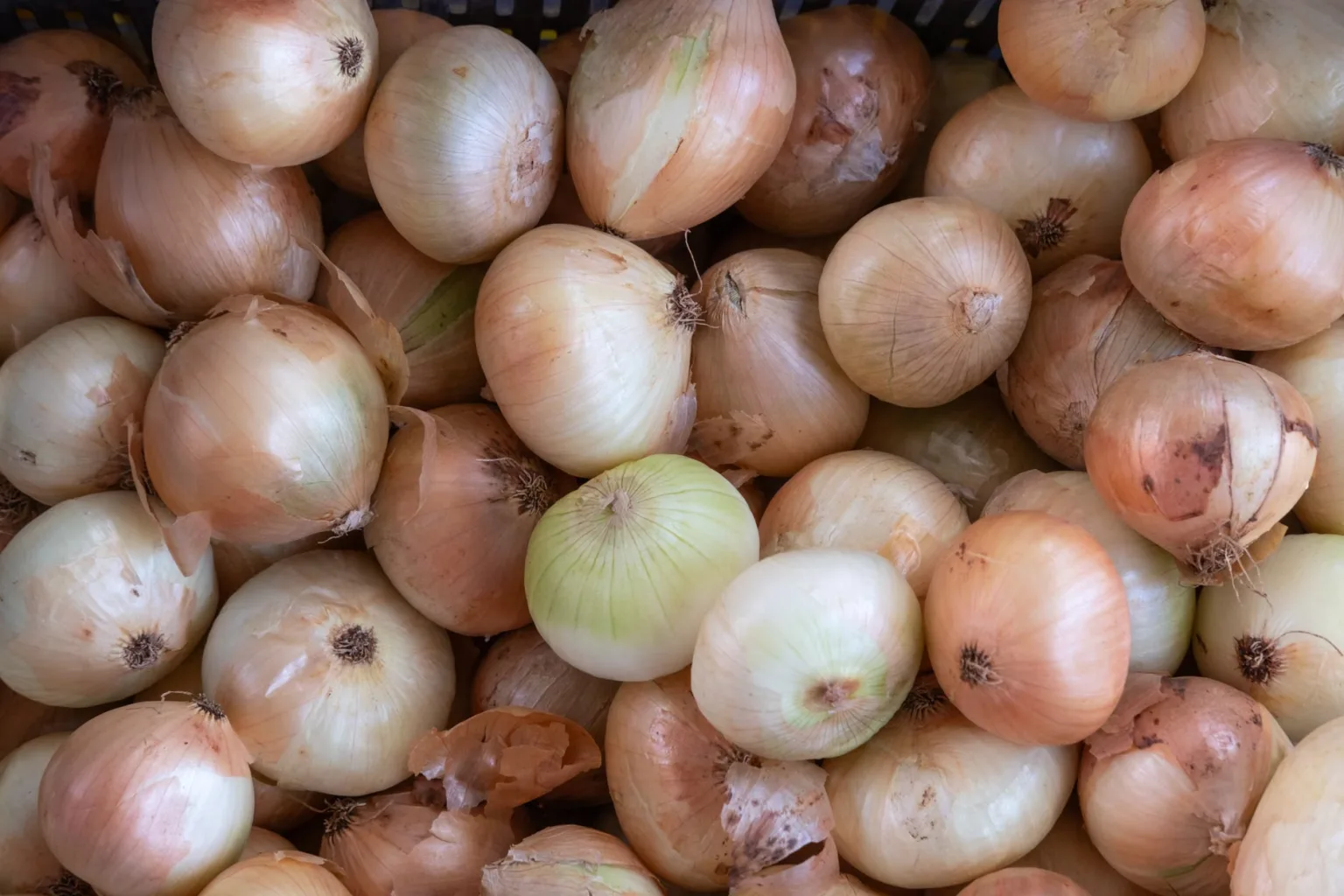
The common onion is the edible bulb of Allium cepa. Its fleshy layers sit beneath an outer skin, and bulbs vary in colour, size, shape and flavour. Yellow, white and red onions are widely available, along with sweet onions and small-bulb types. They do not all behave alike: some are milder and crisp when raw, while others are well suited to longer cooking. The word onion can also be used loosely for different products, such as spring onions or shallots. It is useful to distinguish these when choosing an ingredient or adapting a recipe, since they do not provide the same texture or flavour.
When to use it
Use onions to build an aromatic base for stews, sauces, soups, stocks and legume dishes. Yellow onion is a versatile choice when a recipe simply says onion, and cooking makes its flavour sweeter. For salads, sandwiches, tacos and fresh salsas, red or white onion can add colour and a crisp bite. Choose according to the result you want: a milder note, a firm raw texture or a more pronounced flavour. These are helpful guidelines rather than fixed rules; the recipe and your own preference matter too.
How to use it
Remove the papery outer skin and cut the onion to suit the dish: dice it finely to blend into a sauce or sauté, slice it into rings or strips for salads and sandwiches, or cut rings for frying and roasting. Raw onion works in salads, tacos and fresh salsas. Some recipes suggest briefly soaking it in cold water to soften its sharpness; drain it before use. For cooked dishes, sauté or simmer the onion until it reaches the colour and texture the recipe calls for. Onions can also be roasted, baked, stewed, fried or pickled. Match the cut and cooking method to the result: a fine dice blends in more readily, while larger pieces keep a more noticeable presence.
Flavour and texture
Flavour varies by variety and preparation: an onion may taste pungent and sharp raw, then become milder and sweeter as it cooks. White onions are often described as crisp and relatively mild; yellow onions have a more pronounced flavour that sweetens with cooking, while red onions are notable for their colour and firm bite. These are broad tendencies, not guarantees for every onion. Cutting and cooking also change the texture, from crisp layers to soft, yielding pieces.
How to choose it
Choose whole onions that feel firm and show no obvious damage; avoid bulbs with soft areas, moisture or visible decay. Skin, colour, size and shape vary by variety, so none is a stand-alone quality test. Think about how you will use the onion: a milder type may suit a raw dish, while a more assertive one can work well as a cooked base. If buying onions in packaging, check the product information, particularly if you need to verify whether sulfites are present.
Storage
Keep whole onions in a cool, dry, ventilated place away from moisture. Avoid a sealed bag if it prevents air circulation. Fresh, delicate types may keep less well than dry onions, so check them and use them before they deteriorate. Once cut, protect the remaining portion and refrigerate it; follow any storage directions on the packaging. Discard onions showing clear signs of spoilage rather than trying to use affected parts.
Substitutions
Shallots can stand in for onions when you want a finer, aromatic note, although their flavour is not identical. Spring onions give a fresher, milder profile and work well raw or in quick-cooked dishes. Chives provide an onion-like aroma but do not replace the bulb's bulk or texture. Onion powder can supply flavour when texture is not needed; the amount depends on the recipe and product.
Common mistakes
Do not assume every onion has the same sharpness, sweetness or texture. A strongly flavoured onion can overpower a raw dish, while a mild one may be less prominent in a long-cooked stew. Do not use the same cut for every purpose: cut size affects how much the onion blends into the dish. Also, common onions, spring onions, chives and shallots are not interchangeable in texture or flavour.
Safety and allergens
If you are sensitive to sulfites, check the label of onions sold in mesh bags or ask the seller: Spain's food-safety agency AESAN notes that one kilogram of mesh-packed onions is likely to exceed 10 mg/kg SO₂. Follow the package's storage directions and discard onions with obvious spoilage.
Culinary uses
- Aromatische Grundlage für Saucen, Suppen, Schmorgerichte und Fonds
- Knackige oder würzige Zutat für Salate, Sandwiches und frische Salsas
Recommended techniques
- Roh schneiden oder in Ringe schneiden
- Anbraten oder langsam weich dünsten
- Backen, rösten, schmoren oder frittieren
- Einlegen
Pairs well with
- Tomaten und Paprika
- Hülsenfrüchte und Getreide
- Fleisch oder Fisch
- Essig oder Zitrusfrüchte
Frequently asked questions
Which onion should I use when a recipe does not specify a variety?
Yellow onion is a versatile option for sautés, stews, stocks and sauces. For a raw dish, choose the variety whose flavour and texture you prefer.
Can onions be eaten raw?
Yes. Onions are used raw in salads, fresh salsas, tacos and sandwiches. Their flavour can be sharper raw than after cooking.
Can mesh-packed onions contain relevant sulfites?
AESAN says a kilogram of onions packed in a mesh bag is likely to exceed 10 mg/kg of SO₂. If you are sensitive to sulfites, check the product information or ask the seller.
Estimated nutrition
- Fat
- 22.2 g
- Saturates
- 3.73 g
- Carbohydrate
- 41 g
- Sugars
- 4.76 g
- Fibre
- 2.4 g
- Protein
- 5.29 g
- Salt
- 1.95 g
Sources and review
Automatically researched, cross-checked and validated content. Sources consulted:
- En el etiquetado alimentario hay algunas menciones que son obligatorias eletiquetadocuentamucho.aesan.gob.es
- Client Challenge doi.org
- ::AESAN:: Agencia Española de Seguridad Alimentaria y Nutrición aesan.gob.es
- Cebolla - Información general frutas-hortalizas.com
- Conoce 15 tipos de cebolla y sus usos en la cocina - Mejor con Salud mejorconsalud.as.com
- Para qué sirve cada tipo de cebolla (y un truco para no llorar al picarla) | El Comidista | Gastronomía | EL PAÍS elpais.com
- La cebolla, ingrediente básico en la cocina | Recetas Nestlé recetasnestle.com.mx
- Guía completa de tipos de cebolla: variedades, propiedades y usos culinarios jardineriaon.com
- Cebollas: variedades, usos y diferencias - CocinoPedia.com cocinopedia.com
- Conoce los diferentes tipos de cebolla: nombres, características y usos - Mariettas mariettas.es
- La cebolla, ese humilde ingrediente tan fundamental | Gastronosfera gastronosfera.com
- La cebolla, ingrediente básico en la cocina | Recetas Nestlé recetasnestle.com.ar
- Allium ascalonicum - Wikipedia, la enciclopedia libre es.wikipedia.org
- ¿Cómo elegir la mejor cebolla para cocinar? Guía de sabores patataslazaro.com
- 10 Sustitutos Increíbles para Cebolla: Cómo Reemplazarla Fácilmente en Casa | Chef Experto chefexperto.com
- Sustituto del cebollín: 7 fantásticas alternativas para tus recetas de cocina scratchingthepitch.com
- Tipos De Cebolla: Descubre Sus Usos Y Beneficios | Brillante brillante.es