- Category
- Sauces and condiments
- State
- Paste
- Usual unit
- g
What it is
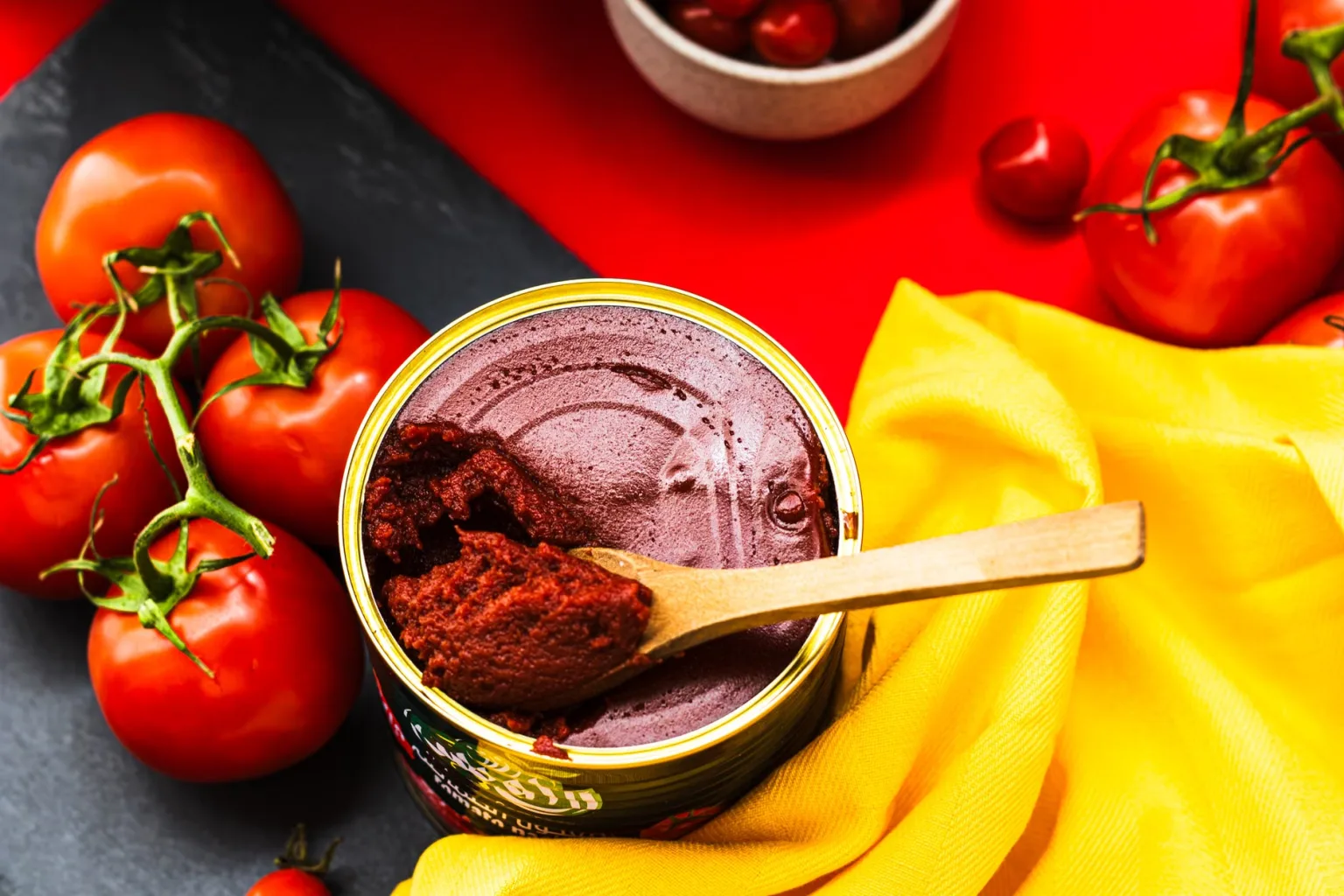
Tomato paste is a thick tomato paste made by cooking tomatoes and reducing some of their water. This concentration gives it a stronger tomato flavor than fresh or canned tomatoes, so a modest amount can noticeably affect a dish. It is used in sauces, stews, soups and savory cooking bases. Commercial products may differ, so check the package for its ingredients and specific directions. Tomato paste should not be confused with a thinner tomato sauce: its dense texture and concentrated flavor make it useful in smaller amounts. The exact composition and handling instructions depend on the product you buy.
When to use it
Use tomato paste when you want a stronger tomato presence without adding as much liquid as fresh or canned tomatoes would contribute. It can be added to pasta or pizza sauces, stews, soups, creams and other savory cooking bases. It is also useful when a recipe already contains liquid and you want tomato flavor without making the mixture as watery as a less concentrated tomato product might. Because its flavor is concentrated, start with a moderate amount and adjust to the dish and the product. It is not an exact, one-for-one replacement for fresh or canned tomatoes in every recipe.
How to use it
Stir tomato paste into a sauce, stew or cooking base so it is distributed throughout the dish. It can be combined with onion and garlic, or with basil or oregano. Begin with a moderate amount: paste is more concentrated than fresh or canned tomatoes, and too much can overpower the other flavors. You can also mix it into a liquid preparation such as soup or cream, stirring until it is evenly incorporated. Adjust the amount to suit the recipe and taste. There is no single substitution ratio that works for every dish, so consider how much liquid and tomato flavor the recipe needs.
Flavour and texture
Tomato paste has an intense tomato flavor and a dense, thick texture that can be stirred into savory dishes. Compared with fresh or canned tomatoes, it delivers more concentrated tomato flavor in a smaller amount. Its effect depends on the quantity used and the particular product. The paste can add body and color to a sauce or stew, but it does not contribute the same amount of liquid as less concentrated tomatoes.
How to choose it
Choose an intact package and check the ingredient list, product format and manufacturer’s directions. Products can differ in composition, so do not assume every one contains only tomato or has identical handling instructions. Select a size that suits the way you cook and that you can manage according to the package directions after opening. Read the label rather than relying on a general rule for all tomato pastes.
Storage
Follow the storage directions printed on the specific package, particularly after opening. Instructions can differ between products, so do not automatically apply one time limit or method to every container. Close the package as directed and check the label before storing it. If the instructions are missing or unclear, ask the manufacturer rather than assuming a universal storage period.
Substitutions
Fresh or canned tomatoes can provide tomato flavor in place of paste, but they are not exact equivalents: they contain more water and have less concentrated flavor. A substitution may make a dish thinner and less intensely tomato-flavored. Adjust the liquid and amount to suit the recipe rather than assuming a fixed ratio. If a thick texture and concentrated tomato impact are important, replacing the paste may change the result.
Common mistakes
A common mistake is adding too much at once: concentrated tomato flavor can take over a dish. Start moderately and adjust to taste. Another is replacing paste with the same quantity of fresh or canned tomatoes without accounting for their higher water content and less concentrated flavor. Do not assume every package has the same storage instructions; follow the directions for the product you have.
Safety and allergens
Check and follow the package’s storage directions, especially after opening. Do not assume one storage period applies to every product; use the instructions for the specific package.
Culinary uses
- Concentrated tomato flavor for sauces, stews and soups
- Flavor base for pasta, pizza and savory fillings
Recommended techniques
- Stir into a sauce or stew during cooking
- Blend into a liquid preparation or cooking base
Pairs well with
- Onion and garlic
- Basil or oregano
Frequently asked questions
How is tomato paste different from tomato sauce?
Tomato paste is a thick ingredient with concentrated tomato flavor; it is not necessarily the same preparation as a thinner tomato sauce. Check the product label for its composition.
How can I use tomato paste?
Stir it into sauces, stews, soups or savory cooking bases. Start with a moderate amount and mix it in evenly.
Can I substitute fresh or canned tomatoes?
They can provide tomato flavor, but they are not an identical replacement: they contain more water and their flavor is less concentrated. Adjust the recipe for that difference.
Estimated nutrition
- Fat
- 0 g
- Saturates
- 0 g
- Carbohydrate
- 21.2 g
- Sugars
- 12.1 g
- Fibre
- 6.1 g
- Protein
- 3.03 g
- Salt
- 1.21 g
Sources and review
Automatically researched, cross-checked and validated content. Sources consulted:
- Client Challenge doi.org
- Los 6 mejores tipos de tomate y cómo usarlos en cocina mercadosantamariadelacabeza.es
- Food & Fun Afterschool hsph.harvard.edu
- Pictorial Recipes - OSU Extension Service extension.oregonstate.edu
- Publications | Food Engineering | Washington State University labs.wsu.edu
- Comité Científico aesan.gob.es
- Salud y seguridad de los trabajadores del tomate hia.berkeley.edu
- Tienda | Store Room stristoreroom.si.edu
- Refinando la Nutrición en los Tomates: Mejor Nutrición para Mejorar el Empaque extension.psu.edu
- study of the sustainability issues of food production using ... upcommons.upc.edu
- El tomate concentrado es un básico en mi cocina, pero siempre se me estropeaba. Hasta que empecé a hacer esto directoalpaladar.com
- ¿Qué es el concentrado de tomate y cómo se usa en la cocina? - Agrupalmería agrupalmeria.com
- Tomate concentrado: el aliado perfecto para tus huevos fritos | Calidad Agroambiental calidadagroambiental.com