- Category
- Vegetables
- State
- Fresh
- Usual unit
- unit
What it is
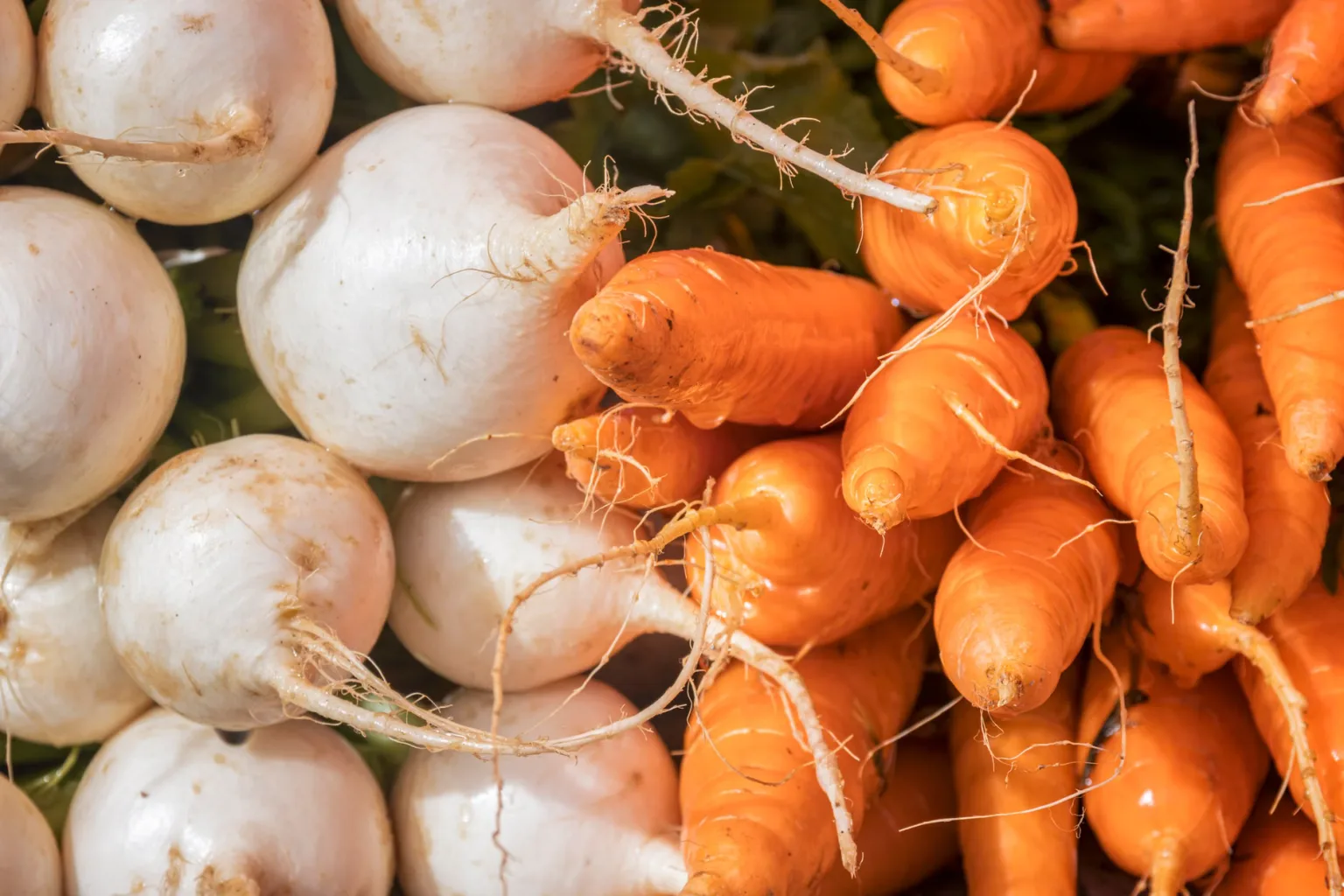
Turnip is a root vegetable in the Brassicaceae family, which also includes cabbages. The root usually has white or yellowish flesh and thin skin that may be white, yellow, or show reddish, green or purple coloring near the top. Depending on the variety, it can be round, flattened or cylindrical, so its appearance and size naturally vary. The leaves can also be eaten when fresh. In the kitchen, the root is used both raw and cooked: raw turnip can be crisp, while cooking softens any peppery edge. Differences in shape, color and size are normal variation between varieties and are not, by themselves, signs of poor quality.
When to use it
Choose turnip when you want a mild, cabbage-like flavor with a slightly sweet note in a broth, soup, purée or stew. Small or medium roots are convenient when a tender result is desired; some varieties are also suitable raw in salads or simply dressed. Turnip pairs with vegetables, meat or fish. Varieties are available throughout the year, although turnips may be more prominent in markets in autumn. Actual availability depends on the variety and location.
How to use it
Remove the leaves if you do not plan to use them, keeping only those that look fresh. Before preparing the root, trim any unwanted parts and cut it to suit the dish. For a salad, some varieties can be eaten raw: slice or dice them and dress as desired. For soups, broths and stews, add turnip with the other vegetables and cook until it reaches the texture you want. You can also cook and purée it for a smooth soup or side dish. Cooking softens the peppery flavor that the root and leaves can have. Once cooked, adjust the seasoning and serve the turnip on its own or with meat, fish or other vegetables.
Flavour and texture
Turnip root tastes somewhat like cabbage, with a slightly sweeter quality; some pieces have a mild peppery edge. Texture depends on both variety and preparation: certain varieties are crisp when raw, while cooking makes the root softer and also mellows its pepperiness. The leaves have a character distinct from the root and can be used as a vegetable when fresh.
How to choose it
Look for small or medium turnips that feel firm, have smooth skin and are heavy for their size. Color can range from white to violet and shape can vary, so those characteristics alone do not indicate a flaw. Avoid roots that are excessively large, marked or fibrous. If sold with leaves, check that the leaves look fresh; remove them if they do not, and use the root.
Storage
If the turnip comes with leaves, remove them before storing the root unless you plan to use them soon. Keep the roots in a perforated plastic bag in the refrigerator and wait to wash them until just before use. The cited guide says they can keep in good condition for one to three weeks; the condition of each root may vary, so check it before cooking. Turnips can also be frozen after brief blanching, using a reliable preservation procedure.
Substitutions
For raw dishes, radish can be an approximate alternative when you want a crisp texture and a broadly similar flavor, though it is not identical. In cooked dishes, cabbage can provide a similarly mild note, but its texture and final result will differ. Adjust the cut and seasoning to suit the recipe rather than expecting an exact replacement.
Common mistakes
Do not judge turnips by color or shape alone: varieties can be white, yellowish or purple-tinged, and their shapes differ. Avoid roots that are excessively large, marked or fibrous. If you are storing a turnip, do not wash it in advance; wait until you are ready to use it. Do not automatically discard the leaves: they can be used when fresh.
Safety and allergens
The sources consulted do not identify a specific safety warning for turnips. Choose roots in good condition and wash them just before preparing or eating.
Culinary uses
- Root vegetable for soups, purées, broths and stews
- Raw, crisp vegetable for salads or simple seasoned dishes
- Edible leafy vegetable when fresh leaves are sold with the root
Recommended techniques
- Serve raw, thinly sliced or grated
- Simmer in soups, broths and stews
- Cook and purée for a smooth soup or side dish
Pairs well with
- Meat
- Fish
- Other vegetables
- Olive oil and salt
Frequently asked questions
Can turnip be eaten raw?
Yes. Some varieties can be eaten raw and are crisp; slice them for a salad or serve them simply dressed.
Can you eat turnip leaves?
Yes, the leaves are edible. Use leaves that look fresh, and remove them from the root before storing it.
How do I choose a good turnip?
Look for small or medium roots that are firm, smooth-skinned and heavy for their size. Avoid very large, marked or fibrous ones.
Are turnips available all year?
Available varieties mean turnips can be found throughout the year, although they may be more prominent in markets in autumn.
Estimated nutrition
- Fat
- 0.3 g
- Saturates
- 0.07 g
- Carbohydrate
- 7.13 g
- Sugars
- 0.81 g
- Fibre
- 3.2 g
- Protein
- 1.5 g
- Salt
- 0.1 g
Sources and review
Automatically researched, cross-checked and validated content. Sources consulted:
- Client Challenge doi.org
- Home Food Preservation and Safety | Penn State Extension extension.psu.edu
- Turnip greens fonddulac.extension.wisc.edu
- Uses and gratifications of the Food Network scholarworks.sjsu.edu
- AusAID. Farm Technology.pdf research.fit.edu
- Nabo: qué es, variedades, beneficios y usos en la cocina bonviveur.com
- Nabos | Gastronomía & Cía gastronomiaycia.com
- Brassica rapa subsp. rapa - Wikipedia, la enciclopedia libre es.wikipedia.org
- Nabo | Introducción | Verduras y hortalizas | EROSKI CONSUMER verduras.consumer.es