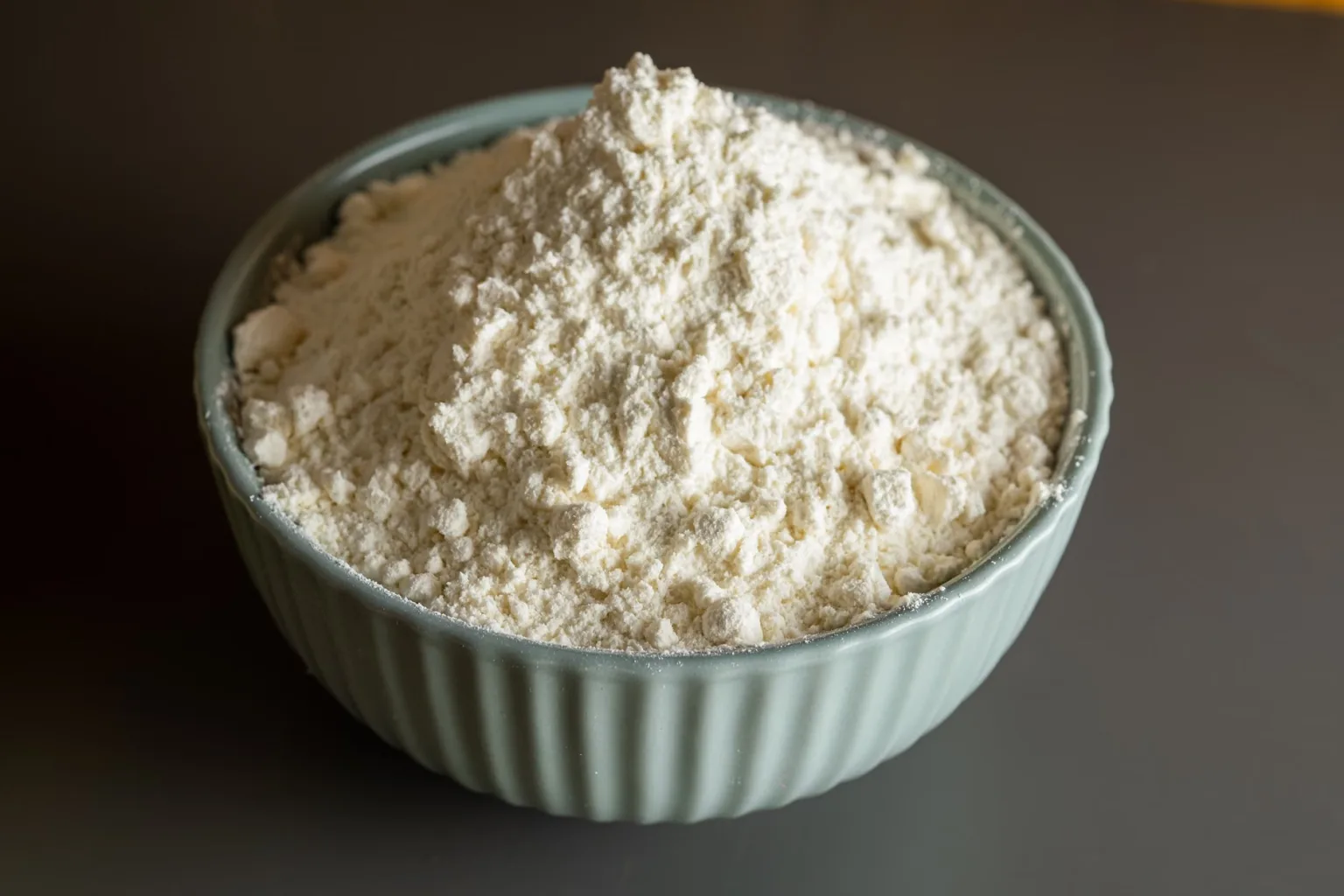
- Category
- Baking
- State
- Powdered
- Usual unit
- cucharadita
What it is
Baking powder is a dry mixture used as a chemical leavener in many baked preparations. It commonly combines bicarbonate with one or more acidic components and, depending on the product, an ingredient that helps keep the mixture dry and free-flowing. When its components react, they release carbon dioxide; the gas bubbles help expand the batter and create a lighter texture. Formulas and activation behavior can vary, so check the package rather than assuming every product is identical. Baking powder is sometimes called chemical yeast in other languages, but it is not baker’s yeast: it works through a chemical reaction, not fermentation by microorganisms.
When to use it
Use it when a recipe for cake, muffins, cookies, or another baked batter specifies baking powder as the leavener. It may also be used in savory preparations, including some batters and coatings. Its role is to help a mixture rise and become less dense; it is not an automatic substitute for baker’s yeast, which works differently. Follow the amount stated in the recipe and consider the product formulation, especially when the recipe already contains acidic ingredients or calls for flour that includes a leavener.
How to use it
Measure the amount specified by the recipe and, when directed, combine it with the dry ingredients, such as flour, before adding liquids. Distribute it evenly so the leavening action is not concentrated in one part of the mixture. Continue with the preparation and baking instructions in the recipe and on the product package. Do not add extra on the assumption that more will make the batter rise higher: too much can create bubbles that break and leave the baked result heavy or sunken. There is no single correct dose for every preparation; the required amount depends on the recipe and the product formula.
Flavour and texture
Baking powder is used mainly for its effect on rise and texture, not as a dominant flavoring. The gas it releases can help create a lighter, airier crumb. Too much can undermine structure and, depending on the formula and preparation, affect flavor. The reaction and final result depend on both the product and the recipe.
How to choose it
Choose a food product clearly labeled as baking powder and read the package for ingredients and directions. Formulas are not necessarily identical: acidic components and other ingredients can differ. Check the package for declared allergens and the manufacturer’s date information. If a recipe calls for a particular type or behavior, do not assume every product will perform in exactly the same way.
Storage
Keep it tightly closed in a dry place and prevent moisture from getting into the container. Use a dry spoon when measuring and do not leave the package open while preparing a recipe. Moisture can affect the product and reduce the expected result. Follow any storage directions printed on the package; use the manufacturer’s information rather than assuming a shelf life.
Substitutions
There is no universal one-to-one replacement. In some recipes, baking soda can be paired with a suitable acidic ingredient, but the amounts and balance depend on the formula. Self-rising flour may work in some preparations if the recipe is adjusted to account for the leavener already in the flour. Baker’s yeast is not an equivalent swap: it works differently and can change the process and texture.
Common mistakes
Do not confuse baking powder with baker’s yeast or with baking soda used on its own. Do not guess the amount or increase it without adjusting the recipe: excess can make bubbles break and leave a heavy or sunken result. Avoid measuring with a damp utensil, and check the package directions because formulas and activation behavior vary.
Safety and allergens
Use it as a food ingredient according to the package directions. Check the label for ingredients and declared allergens, since product formulas can vary.
Culinary uses
- Chemical leavener for raising batters and doughs
- Texture aid for lighter, more open baked goods
Recommended techniques
- Measure according to the recipe and combine with the dry ingredients
- Bake the prepared batter or dough promptly according to the recipe
Pairs well with
- Cake, muffin, and cookie batters
- Savory batters and coatings
Frequently asked questions
Is baking powder the same as baker’s yeast?
No. Baking powder releases gas through a reaction between its components; baker’s yeast is a microorganism that ferments. They are not interchangeable without adapting the recipe.
Can I replace it with baking soda?
It is not usually a direct replacement. Baking soda needs a suitable acidic ingredient, and the amount depends on the recipe. Use a reliable substitution formula rather than swapping equal amounts.
How can I keep baking powder in good condition?
Keep the package closed and dry, and measure with a dry spoon. Follow the storage directions and date information supplied by the manufacturer.
Estimated nutrition
- Fat
- 0 g
- Saturates
- 0 g
- Carbohydrate
- 0 g
- Sugars
- 0 g
- Protein
- 0 g
- Salt
- 14.58 g
Sources and review
Automatically researched, cross-checked and validated content. Sources consulted:
- TIEMPO-TEMPERATURA.pdf aesan.gob.es
- En el etiquetado alimentario hay algunas menciones que son obligatorias eletiquetadocuentamucho.aesan.gob.es
- ¿Por qué la muerte es origen de miedos y tabúes? doi.org
- Polvo gasificante - Wikipedia, la enciclopedia libre es.wikipedia.org
- Quisiera saber dónde se inventó el polvo de hornear y cuál fueros sus ingredientes. . | La Verdad gastronomia.laverdad.es
- ▷ ¿Qué es el polvo de hornear y para qué sirve? | Como Cocinar y Comer comococinarocomer.com
- Descubre Qué es el Polvo para Hornear y Cómo Usarlo para Lograr Postres Perfectos - Restaurante Marcos restaurantemarcos.es
- ¿Qué es el polvo para hornear y para qué sirve? - Rexal rexal.com
- Polvo De Hornear: Ingredientes, Tipos Y Usos | Doctor Online doctor-online.com.ar
- Productos: el polvo de hornear | Recetas.com recetas.com
- ¿Qué es el polvo para hornear? hz-focus.com
- Descubre qué es el polvo para hornear y de qué está hecho eluniversal.com.mx
- Mejorando tu Paella: Análisis y Comparativa de los Mejores Polvos de Hornear (Baking Powder) para una Textura Perfecta recetaspaella.es
- ¿Con qué se puede sustituir el polvo para hornear? ✅️ Sabor a Tierra y Mar saboratierraymar.es
- 5 productos que sirven de sustitutos para el polvo de hornear panaderiatito.com
- 5 ingredientes que sustituyen el polvo de hornear - Mejor con Salud mejorconsalud.as.com