- Category
- Herbs and spices
- State
- Fresh
- Usual unit
- piece
What it is
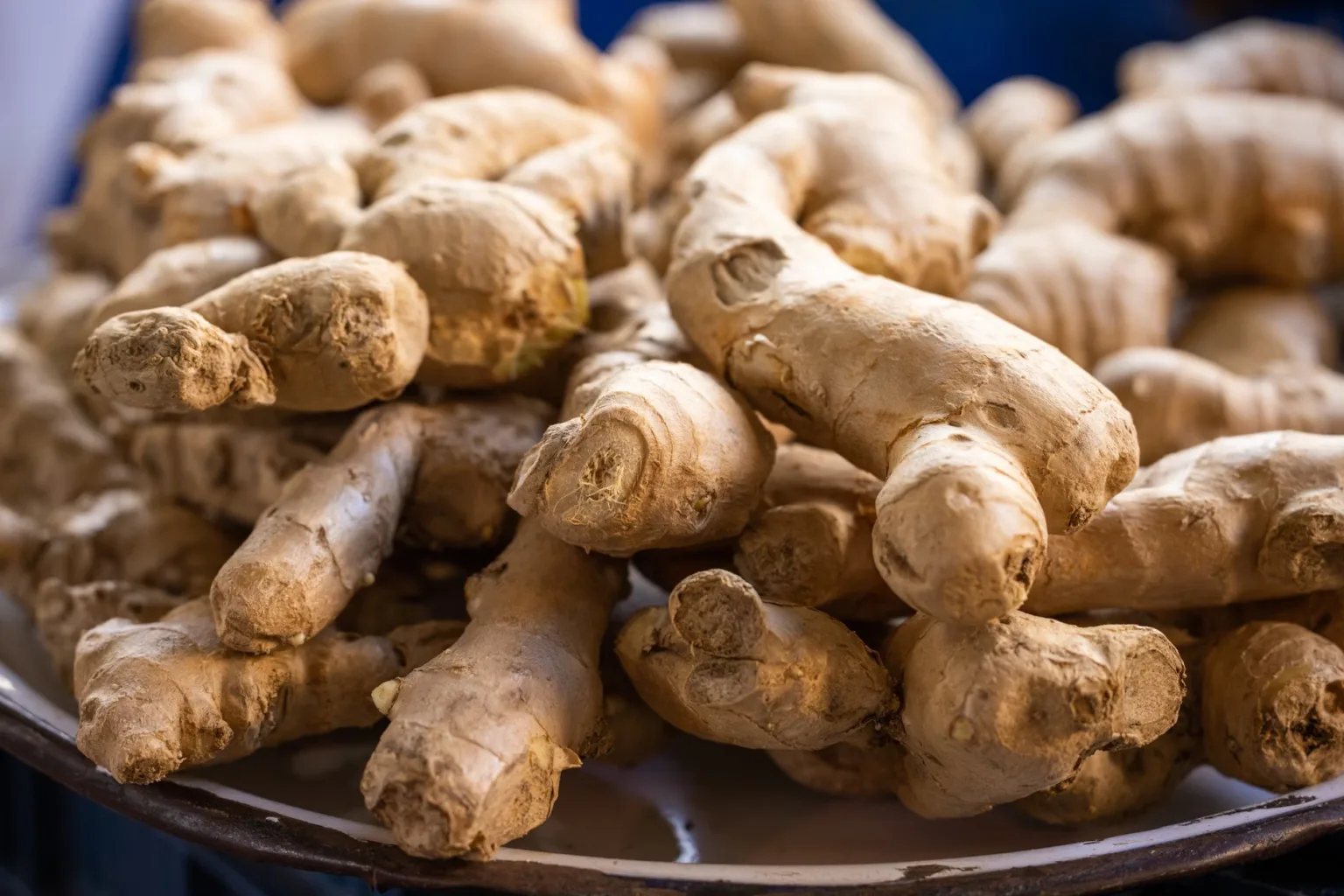
Culinary ginger is the rhizome—a thickened underground stem—of Zingiber officinale, not a true root in the botanical sense. Fresh ginger is sold as a knobbly piece with skin that may be delicate or more corky depending on maturity, and an interior that is generally pale yellow. Its aroma is pronounced and its flavor pungent, sometimes with a citrus-like note. Young ginger tends to be juicier, tenderer, and milder, while more mature ginger can be drier, more fibrous, and hotter. This character makes it useful as a seasoning in savory food as well as in drinks, preserves, and baking. Fresh ginger is a different form from dried, ground, or preserved ginger, so they should not automatically be treated as identical ingredients.
When to use it
Use fresh ginger when you want an aromatic, warm, pungent note in a dish, from a stir-fry, curry, soup, or marinade to a drink or spiced dessert. Tender young pieces can also work well sliced for pickling. For a gentler flavor, infuse ginger in a liquid; grate or chop it when you want it distributed through the food. Its intensity changes with maturity and cut, so adjust the amount to taste and to the role it plays in the recipe.
How to use it
Wash and prepare the amount you need, then grate, chop, or slice it according to the result you want. Grated or chopped ginger can go directly into stir-fries, curries, soups, and marinades; slices can flavor food during cooking or be used for pickling. For a subtler effect, infuse ginger in a liquid and remove it if you do not want pieces in the finished dish. It is also used in drinks, spice blends, preserves, and baked goods such as spiced breads and cookies. Fresh ginger and dried ground ginger have different culinary profiles, so they are not always interchangeable without changing the result. Start with a small amount and adjust as you taste, especially when the strength of the piece is unfamiliar.
Flavour and texture
Its aroma is pronounced, and its flavor combines pungency with warmth and sometimes a citrus-like note. Young rhizomes tend to be juicier, fleshier, and milder; with maturity they can become drier, more fibrous, and hotter. Grating disperses the flavor and blends the texture into a dish, while slices leave distinct pieces and can infuse food.
How to choose it
Choose firm pieces with relatively smooth skin, and avoid ginger that is soft or moldy. Very delicate skin can be normal on young ginger; a more fibrous texture and stronger flavor are normal differences associated with maturity. If you want tender slices or pickles, look for young ginger when available. Handle it gently: delicate skin can be damaged, and damaged areas may spoil.
Storage
Suggested options for fresh ginger include keeping it in a cool, dry place or in the refrigerator; it can also be frozen for longer storage. Keep the piece in good condition and check it before use. No universal storage duration is established here, so do not assume a fixed shelf life for every piece: follow any package directions and discard ginger with mold or obvious deterioration.
Substitutions
Dried or ground ginger can work in some recipes, but its flavor is not identical to fresh ginger and it does not always replace it well. Pickled or preserved ginger can also add flavor in suitable dishes, though its preserving ingredients affect the result. There is no universal quantity conversion given here; choose according to the dish and adjust cautiously.
Common mistakes
Do not assume young and mature ginger have the same strength or texture. Nor should fresh ginger be treated as an automatic equivalent for dried ground ginger, or vice versa: their culinary profiles differ. Avoid soft or moldy pieces, and do not mistake plants called wild ginger for the edible culinary rhizome.
Safety and allergens
Use ginger identified as culinary Zingiber officinale, and do not eat wild plants merely because they are called ginger: some wild gingers are not edible. For packaged or prepared products, check the label for ingredients and any storage or use directions.
Culinary uses
- Aromatizante fresco para platos salados, bebidas y repostería.
- Condimento picante y aromático para curris, sopas, salteados, marinadas y encurtidos.
Recommended techniques
- Rallar o picar para incorporarlo directamente a una preparación.
- Cortar en láminas para cocinar o encurtir.
- Infusionar en líquidos para obtener un sabor más suave.
Pairs well with
- Frutas y preparaciones dulces.
- Té, curris, sopas y salteados.
- Marinadas, conservas y repostería especiada.
Frequently asked questions
Is fresh ginger a root?
It is often called a root in everyday cooking, but the edible part is a rhizome, a thickened underground stem.
Can I replace fresh ginger with ground ginger?
Sometimes a recipe can be adapted, but the two are not identical and ground ginger does not always replace fresh well. Choose based on the dish and adjust the flavor.
How should I store fresh ginger?
Store it in a cool, dry place or in the refrigerator; it can also be frozen. Follow package directions if provided, and do not use pieces with mold or obvious deterioration.
Estimated nutrition
- Fat
- 0.75 g
- Saturates
- 0.2 g
- Carbohydrate
- 17.8 g
- Sugars
- 1.7 g
- Fibre
- 2 g
- Protein
- 1.82 g
- Salt
- 0.03 g
Sources and review
Automatically researched, cross-checked and validated content. Sources consulted:
- En el etiquetado alimentario hay algunas menciones que son obligatorias eletiquetadocuentamucho.aesan.gob.es
- Client Challenge doi.org
- The Essential Glossary of Cooking Terms for the Culinary Arts - Escoffier escoffier.edu
- Ginger, Zingiber officinale – Wisconsin Horticulture hort.extension.wisc.edu
- Noticias del Exterior : boletín de información internacional ... mapa.gob.es
- El jengibre en la cocina asiática dragonimperial.es
- Jengibre: qué es, propiedades, beneficios y cómo se toma bonviveur.com
- Jengibre, más que una especia: usos, formatos y qué puede aportar a tu bienestar margavilan.substack.com
- El jengibre desde una perspectiva profesional | Alveus alveus.eu
- Ready for the Real World | Institute of Culinary Education ice.edu
- USDA FoodData Central libguides.marist.edu
- CULA - Culinary Arts | Montana State University Academic Catalog catalog.montana.edu
- Global Cuisine Cooking Lessons: Pearl River Deli Cantonese | Fowler Museum at UCLA fowler.ucla.edu
- Make Your Own Mix | Cooperative Extension Service uaf.edu
- Storing Food for Safety and Quality ucanr.edu
- Todo lo que necesitas saber sobre el jengibre | American Diabetes Association diabetesfoodhub.org